
A Call to Fiber Magic
This piece appeared in the first issue of wovenutopia magazine.
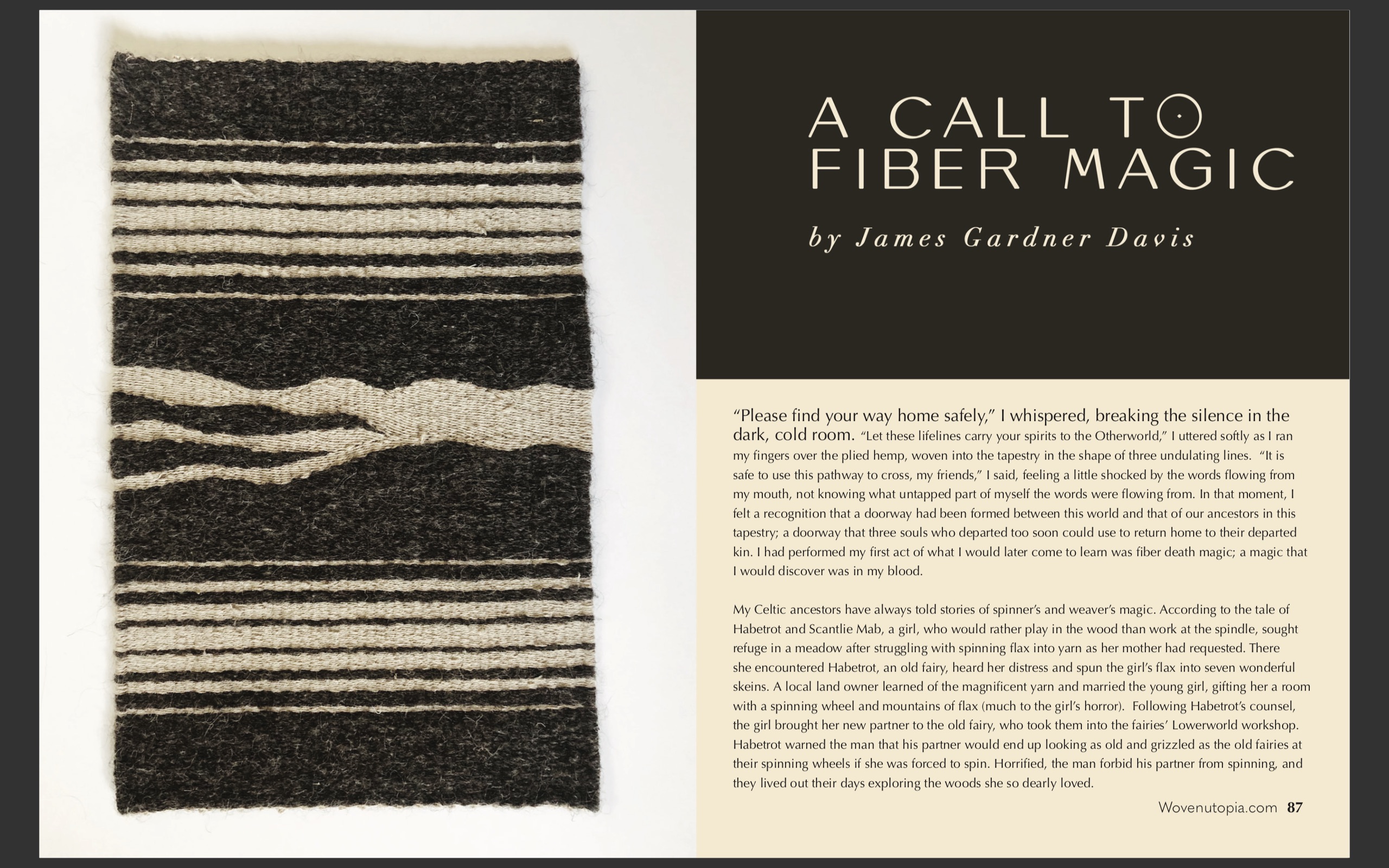
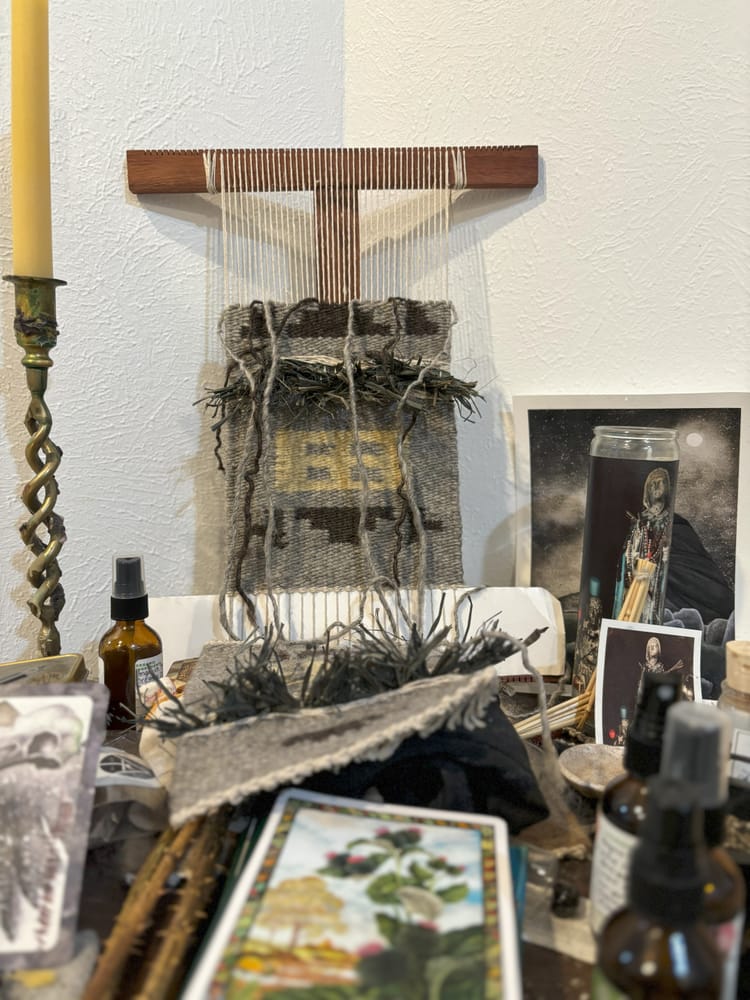
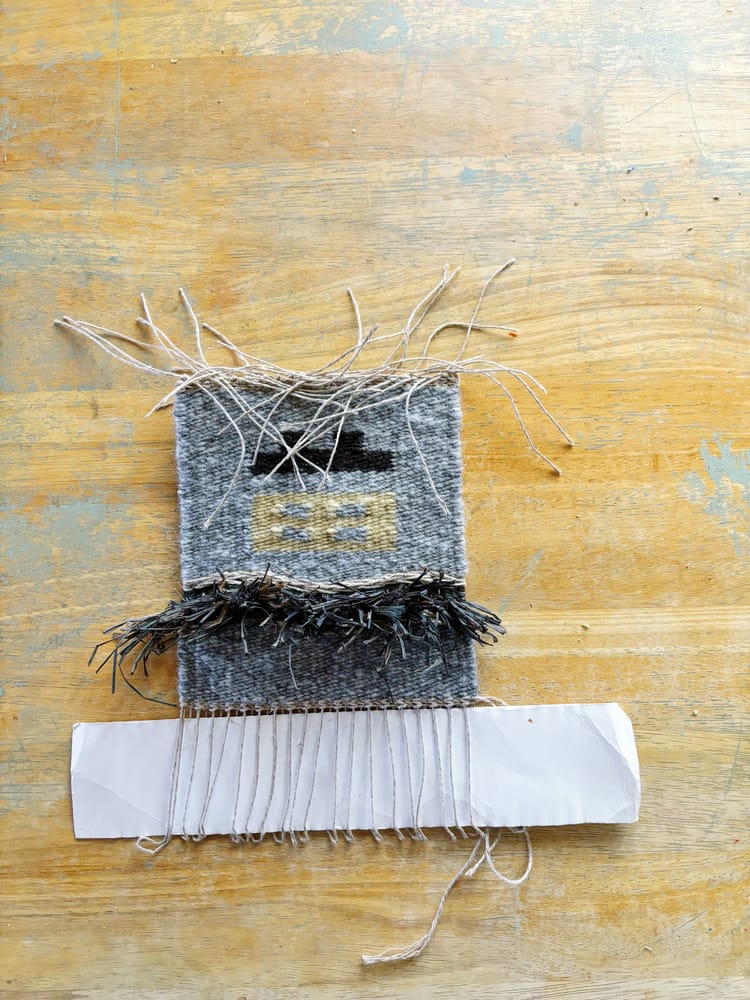
“Please find your way home safely,” I whispered, breaking the silence in the dark, cold room. “Let these lifelines carry your spirits to the Otherworld,” I uttered softly as I ran my fingers over the plied hemp, woven into the tapestry in the shape of three undulating lines. “It is safe to use this pathway to cross, my friends,” I said, feeling a little shocked by the words flowing from my mouth, not knowing what untapped part of myself the words were flowing from. In that moment, I felt a recognition that a doorway had been formed between this world and that of our ancestors in this tapestry; a doorway that three souls who departed too soon could use to return home to their departed kin. I had performed my first act of what I would later come to learn was fiber death magic; a magic that I would discover was in my blood.
My Celtic ancestors have always told stories of spinner’s and weaver’s magic. According to the tale of Habetrot and Scantlie Mab, a girl, who would rather play in the wood than work at the spindle, sought refuge in a meadow after struggling with spinning flax into yarn as her mother had requested. There she encountered Habetrot, an old fairy, heard her distress and spun the girl’s flax into seven wonderful skeins. A local land owner learned of the magnificent yarn and married the young girl, gifting her a room with a spinning wheel and mountains of flax (much to the girl’s horror). Following Habetrot’s counsel, the girl brought her new partner to the old fairy, who took them into the fairies’ Lowerworld workshop. Habetrot warned the man that his partner would end up looking as old and grizzled as the old fairies at their spinning wheels if she was forced to spin. Horrified, the man forbid his partner from spinning, and they lived out their days exploring the woods she so dearly loved.
Habetrot’s story demonstrates that my Celtic ancestors believed spinners and weavers were boundary tenders, folx who use magic to help others cross the major thresholds of life, such as birth, death, and rebirth. Habetrot comes to the aid of a girl who is struggling to cross the threshold into womanhood and marriage. Habetrot uses her magic to take the girl by hand and ensure that she is safely minded in her rebirth as a married woman. Though we do not possess the power of fairies like Habetrot, we possess our own fiber magic that allows us to attend to these thresholds. We, too, can come to the aid of those calling out in distress, take them by the hand, and gently lead them across the thresholds of birth, death, and rebirth. Such is my ancestral birthright, which flows freely through my blood as a Celtic Druid.
Alas, those of us of Northern European descent lost sight of this birthright when our industrial capitalist society cast a spell on us. The clock, the coin, and logic rule our day. The old stories of our ancestors that speak to us of our magic have been hidden away or silenced. Men who sought to make small fortunes locked that magic away within spinning and weaving machines in far away factories, taking away the centrality of our cræft practices from our communities. Other bits of that traditions died away with ancestors who were cast aside along the way as inefficient or backward. In its place, we were handed a rootless whiteness and dependence on machines for our textiles and thread, which disconnects us from the sacred magic of our ancestral traditions. The incantation of the industrial capitalist hoped to make us forget there was ever another world where we weren’t just white consumers.
I broke the industrial world’s spell on me while weaving my way back into connection with my mom and my ancestors. After my mom passed on seven years ago, I learned to weave, because it was a dream she was unable to accomplish before she died. Bringing my completed weavings into my druidic sacred grove with my mom and Celtic ancestors, I communed with them, learning first hand how to practice their elemental and death magic while weaving. Thecosmology and spirituality of my Celtic ancestors that I discovered in that circle filled the void of whiteness that once made me a hungry ghost seeking wisdom from other culture’s wisdom traditions. Little-by-little, I stepped into the power of practicing fiber magic as a druid within my own ancestor’s traditions. The magic of my ancestor’s cræft practices broke the industrial world’s spell to connect me to the olde ways and root me within my own lineage.
Weaving flowing pathways of hemp into my works and blessing those tapestries in ritual circle, I opened pathways from our world to the Otherworld for the departed to pass through. In the dark, liminal space of ritual, those hemp pathways came alive with the glow of sacred light, illuminating the way home for the departed. Hannah Haddadi, a Persian death witch and medium, then brought the weavings into ceremony and guided the departed across that threshold into the Otherworld. As Hannah and I’s collaboration grows, our magic has grown more powerful, providing passage for more and more people who may not have experienced a good death, a death that is tragic or not in accordance with their wishes. Little-by-little, I have embraced path that my own mother’s passing set before me: to use fiber death magic to help those stuck in the liminal space of death.
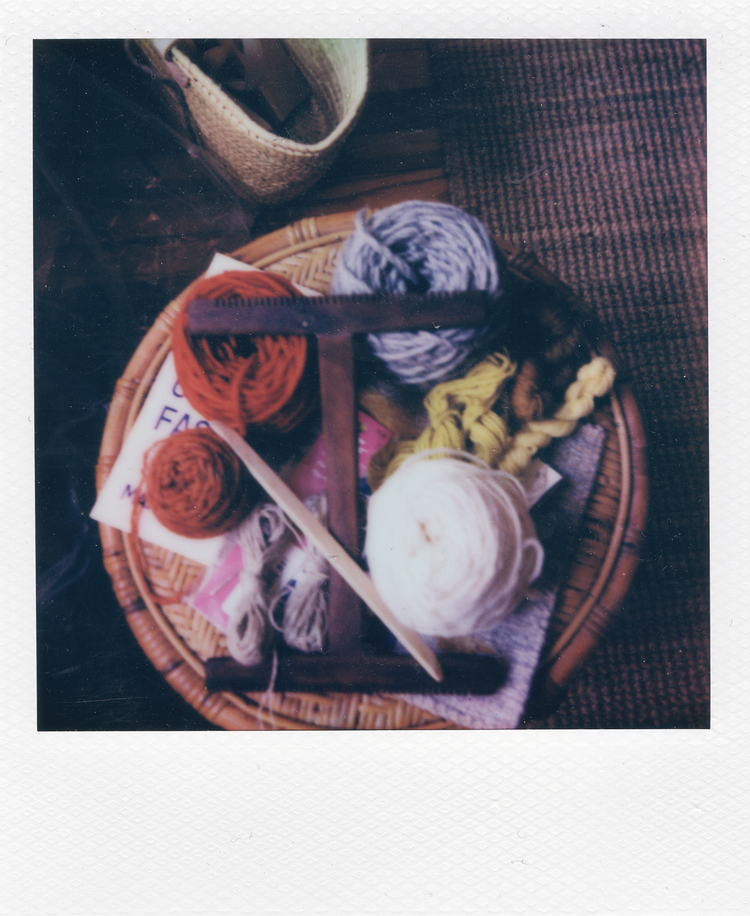
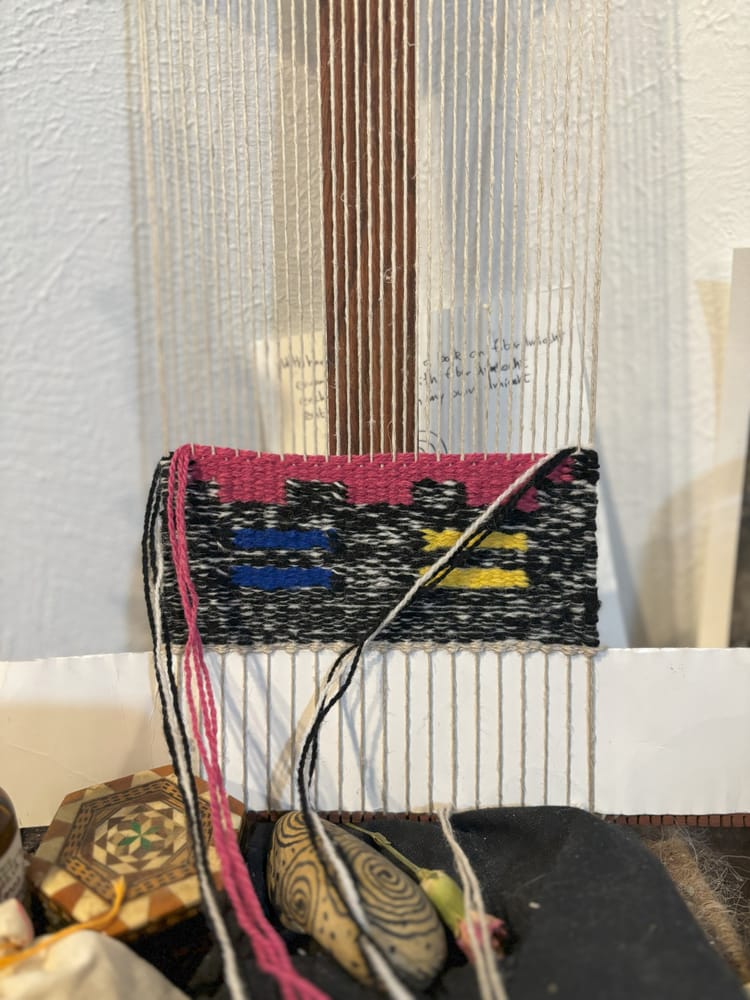
Weaving simple altar cloths with my own handcarded, handspun yarn, I began to understand the earth magic I wielded in my work. While carding, I could feel the sun’s warm glow emanating from the sunkissed, blonde streaks on locks of chocolate brown wool. While spinning, I could feel the rich soil and drenching rains that nourished the sheep in the strong, lanolin-rich fiber. While weaving, I saw designs emerge that were shaped by the wind-swept meadow where the sheep grazed lazily in rhythm with the seasons. Participating in these timeless cræfts, I discovered that I was spinning and weaving the free-flowing energy of the earth, what druids call nwyfre, into the nooks and crannies where weft met weft. I was weaving powerful altar clothes that were capable of holding sacred objects and opening portals between worlds during ceremonial rites.
I urgently make a call out to you fiber workers, especially those of Northern European descent: Invite this magic and connection into your practices. Our work is not merely interior decoration or art to be hung in galleries. No, magic pours out of our hands when we make yarn, knot rope, or weave. Our work connects us with our ancestors, bridges worlds, and has the power to alter the course of history. We are the tenders of of the olde ways, the keepers of the cræfts. We are pure magic; our ancestors wildest dreams. Together, we can weave the new world we so desperately need into being by rooting ourselves in our ancestor’s traditions and making a clean break with the racism, sexism, classism, homophobia, transpobia, and xenophobia that has demarcated the whiteness handed to us at birth. We can weave a world that interns the void of whiteness in its final resting place and finds a way to address climate change by living in harmony with the earth, as our own ancestors did. Such is my dream for our craft’s future. I hope it can be yours too.
Member discussion