
"Please, Don't Pray For Me"
I keep finding myself in French theory again and again. Even if I swear it off for years, I cozy up to some French theorist from the 19 or 20th century and find some deep, ineffable longing expressed in a way I never thought could be brought into words. It all started with Foucault for me. He helped me answer the fundamental question of my 20s: how is our deeply unequal society maintained? His theoretical toolkit helped me understand that a world where dramatic wealth inequality was justified as natural and proper through storytelling. I was able to use his knowledge/power tool kit to see how the American project, you know the RAH RAH, support the troops, pull your self up by your bootstraps BS, has been able to shift how they demonize or “other” alternative political and social projects in order to marginalize those social movements seeking to bring about a more equitable and free America. If one looks to the major american newspapers, all controlled by wealthy folx who would like an outsized role in American culture, you can see an example of how storytelling around radical american projects has always been more interested in casting aspersions at people seeking a fair shake for everyone than reporting the facts of their work.
Yes, I was a real fun chap to be around in college, doing historical analyses of newspapers to chart how patriotic and nationalist ideas were used to discredit and delegitimize the American Socialist movement from the 1850s to the 1950s. Yet, this is the sort of milieu that made me feel so alive. Yes, listening to any manner of oddball music and reading and applying French social theory was my idea of setting my world on fire with passion. Yes, there was also the sportsball and the partying in college, the “chad life” one might call it. Yet, long after I have left behind both those chad pursuits, French social theory, and social theory more generally, have remained. This whole project, to some extent, is an attempt to formalize an engagement with that past version of myself who was devoted to being a theorist, philosopher, critic of the lives we live in this incredibly dynamic moment in history.
I have already told the story of how I had to sell off this skill set in sociological analysis in order to make money to survive. In classic Marxian fashion as described in DAS KAPITAL, I was stuck in the loop of CMC. I had to sell my brain labor power my only C-commodity) to someone who owned a business power in the market place in order to secure the Capital M-money, or the dolla-dolla bills in popular nomenclature, that I would use to purchase the Capital C-Commodities like food, shelter, and insurance I needed to survive. One of the funny things about growing up, or it could be depressing honestly, is when social theory actually gets real. I had an understanding of this classic CMC cycle of exploitation, but didn’t realize how soul crushing it was to have to force something you love into this cycle. It wasn’t until I felt the alienating effects of answering other people’s questions for money that I realized the emptiness of capitalism. No amount of interviewing or data analysis as an academic will teach you that. You just have to embody it as an everyday experience in order to truly understand the dark, vapid void that is being a cog in someone else’s machine with access to the company coffee pot.
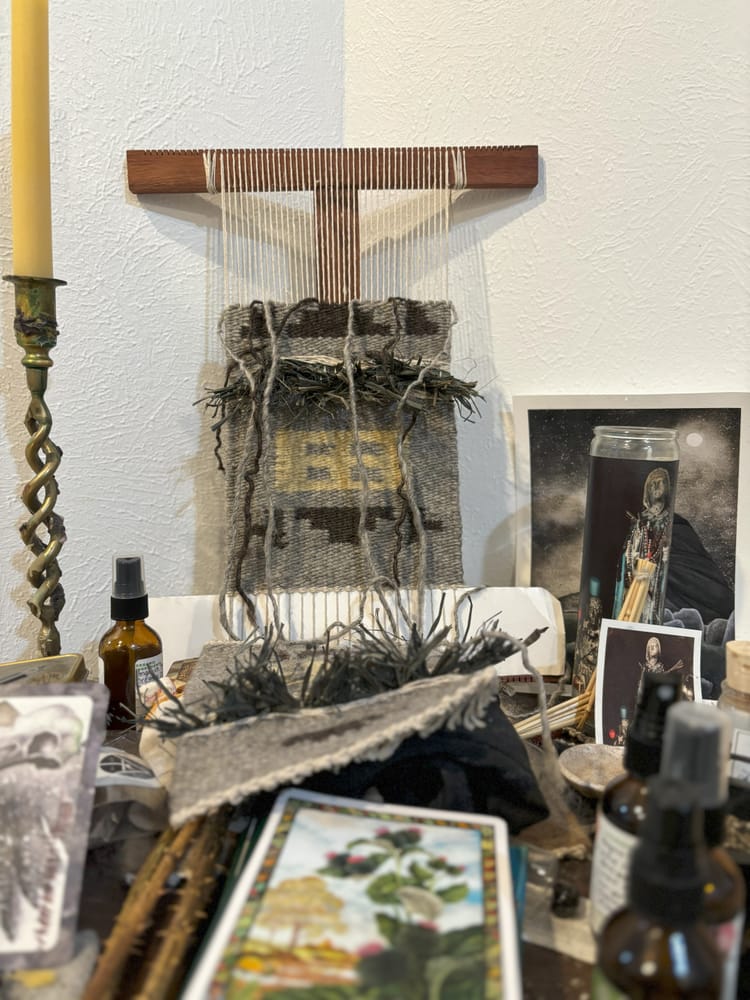
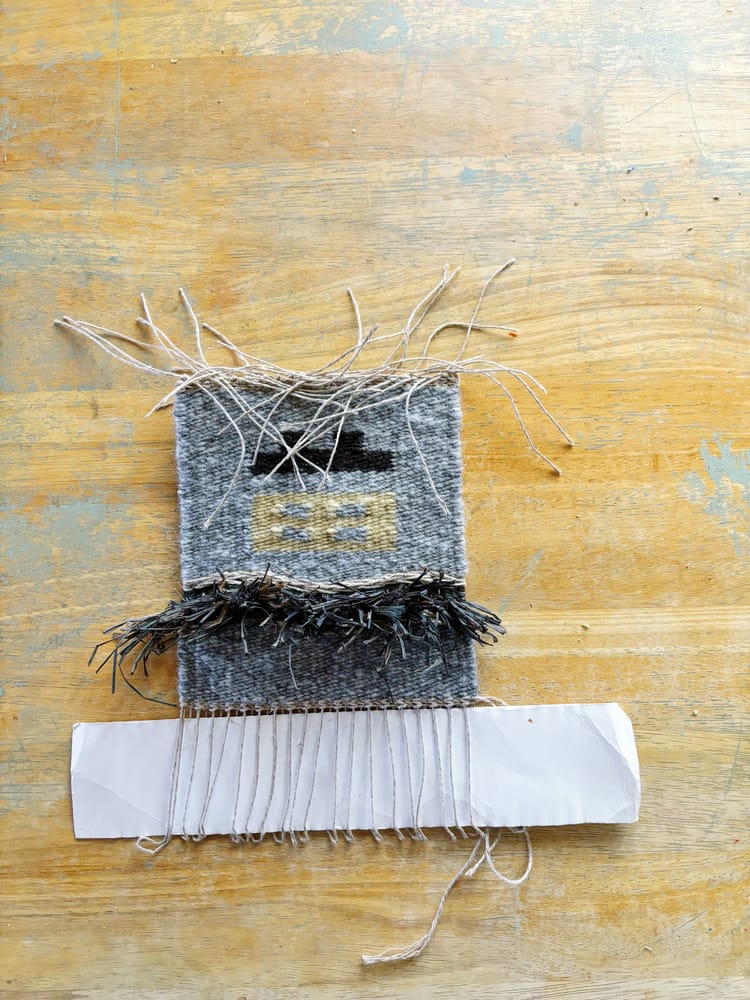
I think my first forays into being devoted to mundane, everyday experience of being an animate meatsack on this planet were all about dissociation and avoidance. Yes, being shot out into the stratosphere in a tin can with a hundred or so other people and landing somewhere across the country to do a job will lead you to embrace any fucking tool that you think will help. It’s still so odd to me that we have normalized burning a bunch of jet fool to go places to answer questions that have no meaning outside of the arcane set of systems we have created for ourselves. Yes, it was Buddhism and its emphasis of dropping into this present moment that I used to manage the anxiety, the OCD of the deep levels of dissonance. It was my tactile bag of fiber art tools that I brought with me that was my comfort blanket. I would sit in a dimly lit hotel room, a room that looked almost the same across the country, and use the repetitions of weaving to sooth out the rough edges of this profound alienation and anxiety that I felt. I would dissociate and beg the system: “Please release me.”
The problem with using someone else’s religion as a coping tool is that at some point when you want to actually address your poblems you gotta drop the act. In preparing to become a parent, I didn’t want to do this meloncholic song and dance any more. I did want to hide or dissociate from the the anxiety and OCD. I knew that I had to abandon my comically white-male approach to buddhism and the 45 minute meditations that were only fueling my OCD. I had to let go of the hope that I could meditate my way directly into the simulation of the “serene, soothing office poster” or the “45 hour waterfall video 432 hz universal healing tone” video. I just wanted to plunge myself into the depths of the difficulties of everyday life without any coping tools. This exposure therapy made the present moment and any focus on everyday living extremely difficult. It was difficult to the point that I completely abandoned any buddhist practice to ensure that I didn’t even have to think about everyday living. Well, that and I really didn’t want to appropriate someone else’s religion anymore and surely didn’t want to practice christianity.
An yet, becoming a father has brought me back to the ability to just inhabit the everyday. In talking about inhabiting the everyday, I am talking about not bailing out into some mental construction of what our actions mean in some grand cosmic sense. Really I am just saying I am not going to do my typical romanticist writer thing I always do today, sulling the good ole mundanity of the stretching hours that I am awake from sunrise to sunset. I am talking about eating some food, reading some things, taking care of my kid, getting some laughs, playing some games, expressing myself some ways, maybe having a sundae (if it’s Friday Night — live MAS, people), and then going to sleep. This is not a zen thing to me any more. No, it’s just living in a biorhythm of my own creation with a toddler who requires this laser focus on the horizon of the next 20 minute attention span. By the end of the care-taking hours, I am toast and ready to sleep to do it again.
I have been waiting YEARS to be able to write a paragraph like that. I have been in the stretching time between -isms, adrift in a sea of wandering. I was wondering when I could reclaim a focus on everyday life again without the needing recourse to talk about zen. I have questioned whether its even useful to focus on everyday life, given so many people in the US use that as their lens for epicurean, dissociative delight. And yet, I am still attracted to the small, improbable moments of wonder, horror, and delight that can come up in a day as it gingerly unfolds itself from the eastern plains and tucks itself back beneath the Eastern-most peaks of the Rocky Mountains. I don’t approach the everyday as an escape or as a means to dissociate from the horrors that surround us on all fronts. I am not on team cozy-at-all-costs, but I won’t deny coziness if it comes home to roost for me. Silence and privacy too, I won’t force them onto a day to turn my senses off to the the entire reality of a day. However, I will cultivate them to turn the noise of a day down to be able to hear, see, and feel more clearly what the day has to offer.
In this way, I am indebted to another French philosopher, Albert Camus, whose work in “The Stranger” I described last week in my essay “Well, It’s All Absurd, Dude.” Of particular note, Camus notes that this entire carnival of a society that we have constructed is absurd, or lacks any real Truth or meaning, in the face of the fact that we all die. Instead, Camus offers us Mersault, his main character in The Stranger, who emphasized again and again how much everything was “all the same to him” and all we have are the experiences that offer themselves to us in each day. Thus, we are transported to world in the Stranger where there is time spent explaining Mersault’s sensory experience when swimming, eating, and smoking. With Camus, I don’t necessarily agree with everything he is saying with this thesis, but his utility lies in de-mystifying our larger structures of religion, politics, economy, and culture to demonstrate how empty they really are. In the void left behind when we abandon the common contemporary aphorisms of “Earn a Living,” “Find God,” “Live your Best Life,” and “Vote Blue No Matter Who,” I find a simple day spent with my loved ones where we navigate together the tremendous difficulty and joy of living in our 21st century neoliberal hellscape.
Henri Lefebrve’s “Critique of Everyday Life” is essential to this sort of reading of everyday living as resistance from so many structures trying to dislodge you from seeing clearly life under bureaucratic and capitalistic domination into an embrace of the marvelous. In Vol 1 of this text, Lefebrve notes how the culture of the 19th century sought to separate ordinary people from the everyday reality by making it subordinate to the marvelous (that which induces wonder):
Since Baudrillard was Lefebvre’s student, you can sort of look at this argument as hyper-reality 1.0 in which the master Lefebrve notes how a culture can disconnect you from the real. Specifically, Henri is critiquing how rationality changed how we as human’s relate directly to “the mysterious, the sacred and diabolical, magical, ritual, (and) the mystical—…(which) were (all) lived with intensity…(and) were part of the real lives of human beings—thoroughly authentic, affective, and passionate forces.”2 In it’s place, Lefebrve thought that artists and intellectuals in the 19th and 20th centuries over-intellectualized and obscured our basic relationship to these sorts of forces in an attempt to remove them from the purview of everyday life, leading us to feeling exhausted and nervous while we are lost in a culture more obsessed with the “facades” that we can place over the everyday to give it meaning than the actual movements and flows of the everyday.3 Here, specifically, Lefebrve is denouncing the poets, “metaphysicians, theologians, and mystics" who (are)seeking ‘another life’ to replace the everyday.4 Sound familiar? Yes, it does turn out that getting lost in worlds of other people’s creation, seduced by their depiction of the marvelous, might be older than I thought.
A simple form of resistance for us to practice today is to not be seduced by the stories or worlds that seek to carry you away from the everyday, the mundane. Here, I am explicitly talking about dispensing with the facades and relating directly to what this day brings you, again in all its horror and joy. It’s embracing the fact that over 150,000 people will die today around the globe, due to genocide, murder, and natural causes, while also being capable of embracing the joy of donut and a hot cup of coffee in the winter sun. Rather than living out some other person’s vision for what a person is supposed to be doing, I want to live the life that presents itself for me where I live through the deeply sacred mysteries, like my own druidic path or my fatherhood path, that present themselves as a “passionate force” in my life.
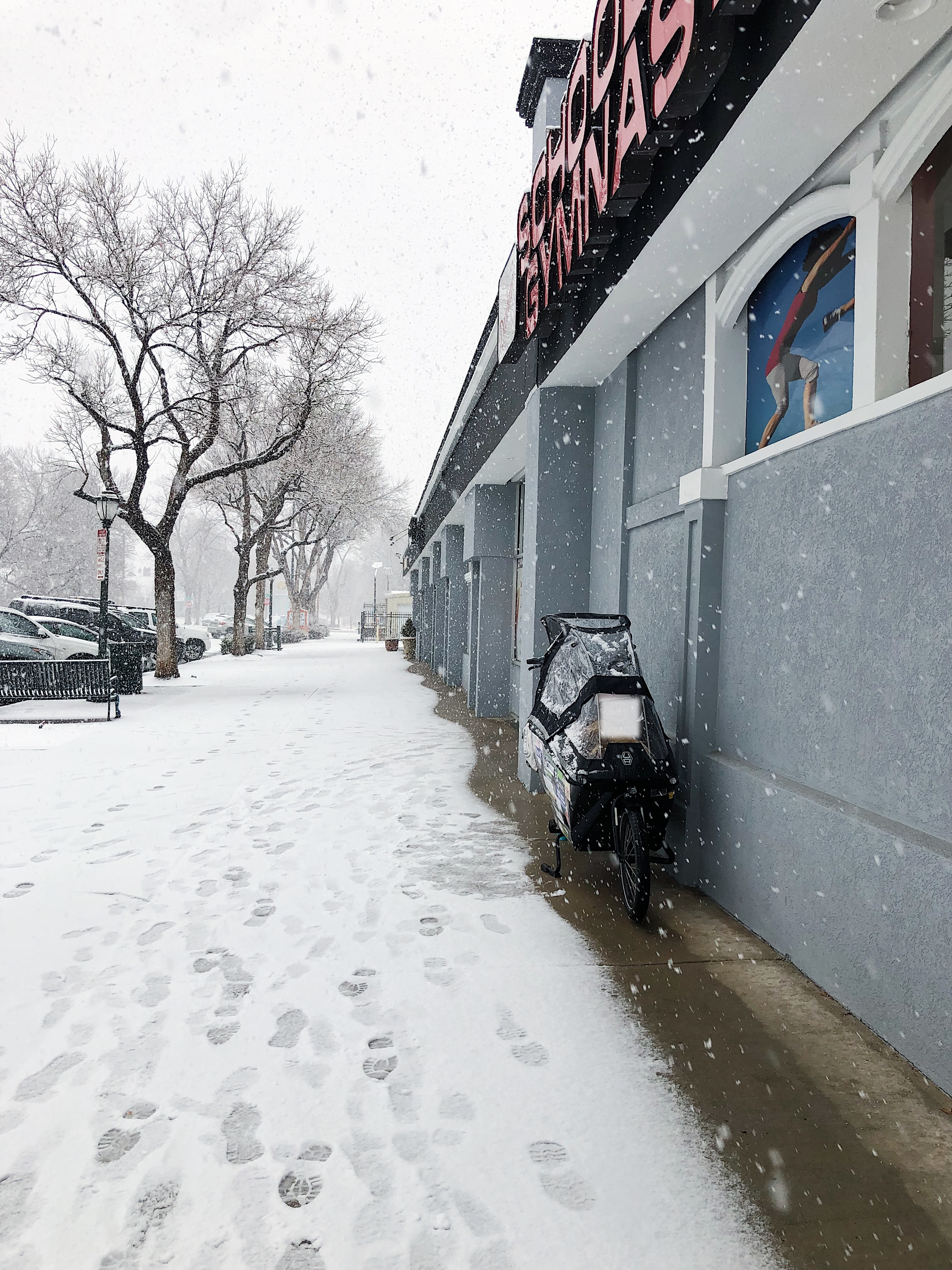
Today, dropping the facade looked like taking Juniper to her gymnastics class on the cargo bike, because I do not own a car. I didn’t make it some big deal on the internet by claiming I was saving the world with riding a bike. If you actually run the stats on fuel savings from riding bikes, its not doing that much. Typically, the machinations of the seasons aren’t too much of an impediment, leaving us sometimes a bit too cold or a bit too hot. Today, an icy rain gave way to blizzard conditions in the manner of the 30 minutes we spent jumping on trampolines.

Consequently, rather than slapping some of my own meaning as a façade over the storm by depicting us CURSED for our infidelity to some great gelatinous glob, Juniper and I just got in rhythm with it, moving slowly threw the growing snow drifts. Our solitary little bike track marked our little break with incessant meaning-making that our society engages in. I took this photo of myself, drenched in direct experience for a chronicle of the way of silent druid.

To those who want to get more cheeky with their dissent of the “influencers” all around us, you may want to respond like Meursault in The Stranger when a priest would not leave him alone on the morning of his execution:
“Yes, my son,” he (the priest) said putting his hands on my shoulder, “I am on your side….I shall pray for you.”
Then, I don’t know why, but something inside me snapped. I started yelling at the top of my lungs and I insulted him and told him to not waste his prayers on me. I grabbed him by the collard of his cassock. I was pouring out on him everything that was in my heart, cries of anger and cries of joy….All that shouting had me grasping for air. But they were already tearing the Chaplain from my grip and the guards were threatening me. He calmed them, though, and looked at me for a moment without saying anything. His eyes were full of tears. Then he turned and disappeared.”5
Consider incoherently screaming the next time you receive a Biden cold-call trying to tell you that this is the most important election of our time and they need your support for fascism with a smile rather than fascism with a punisher sticker. You could also just start making beep noises during your performance review for your job when asked how you have contibuted to improving the efficiency of customer service in the office. There are all sorts of was to get folx to leave us alone when they are trying to sway you. You do you though. It’s just a funny suggestion.
All my best, until next time. Thank you for being here.
James
Member discussion