
"May You Be Protected on Your Creative Path"
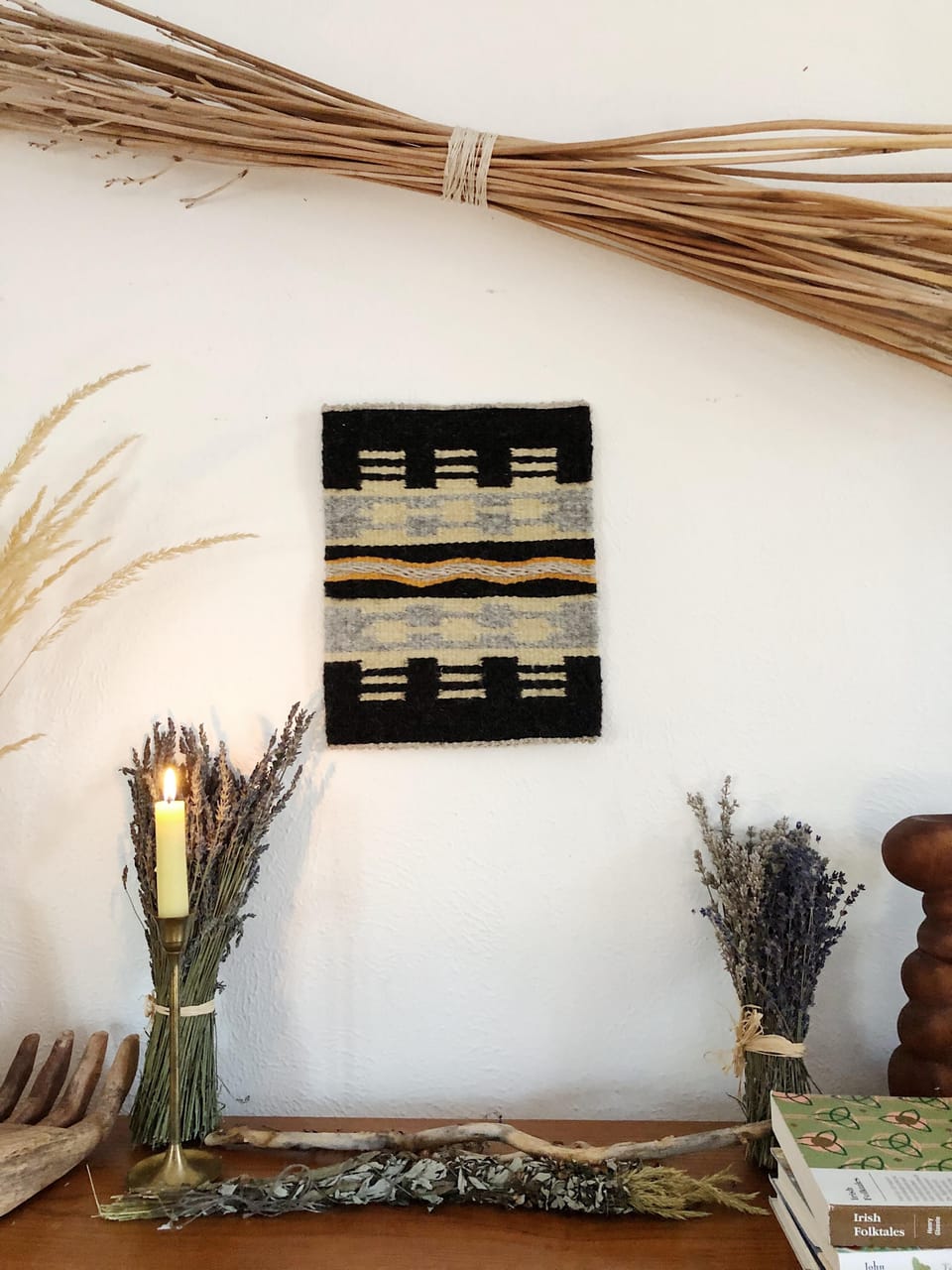
"May You Be Protected on Your Creative Path"
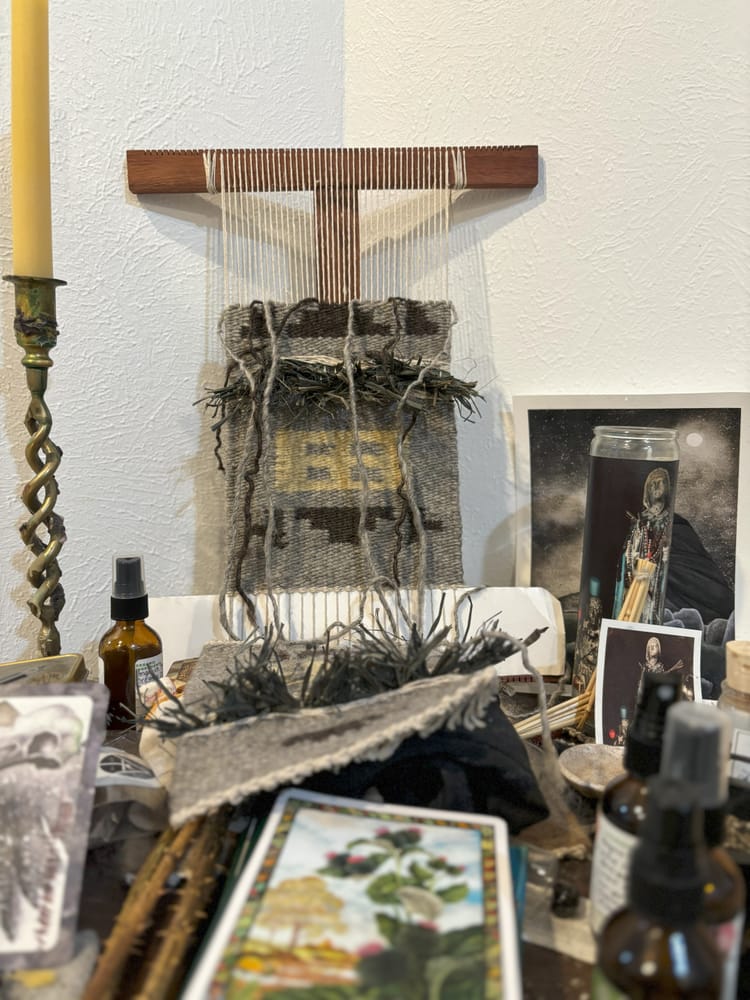
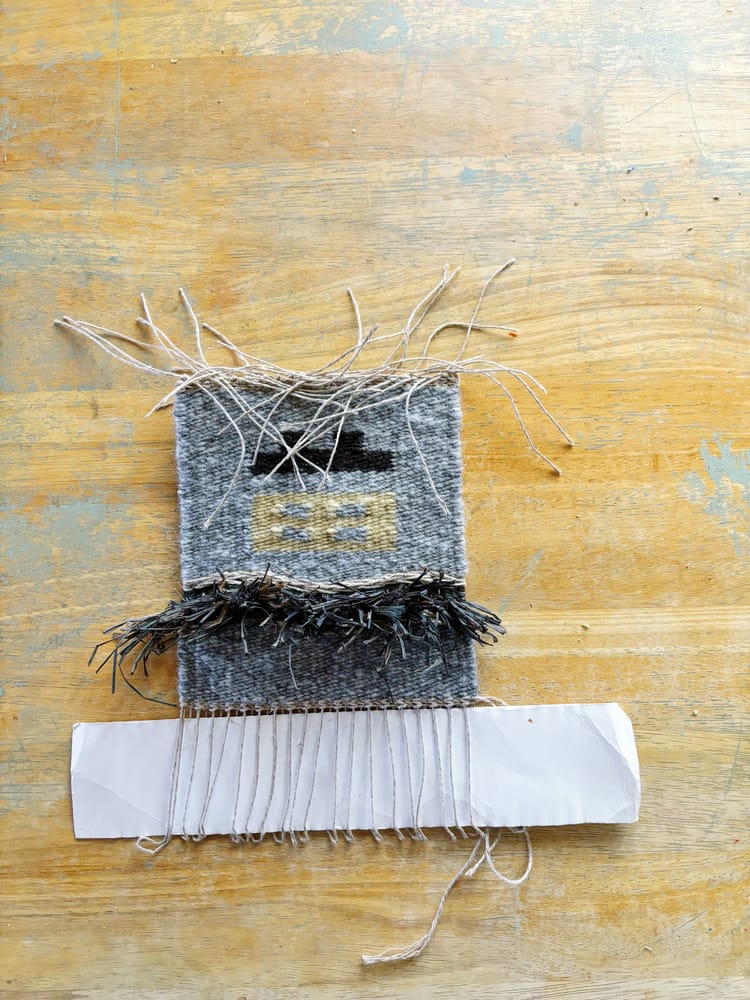
Approximately 12 in. x 10 in.
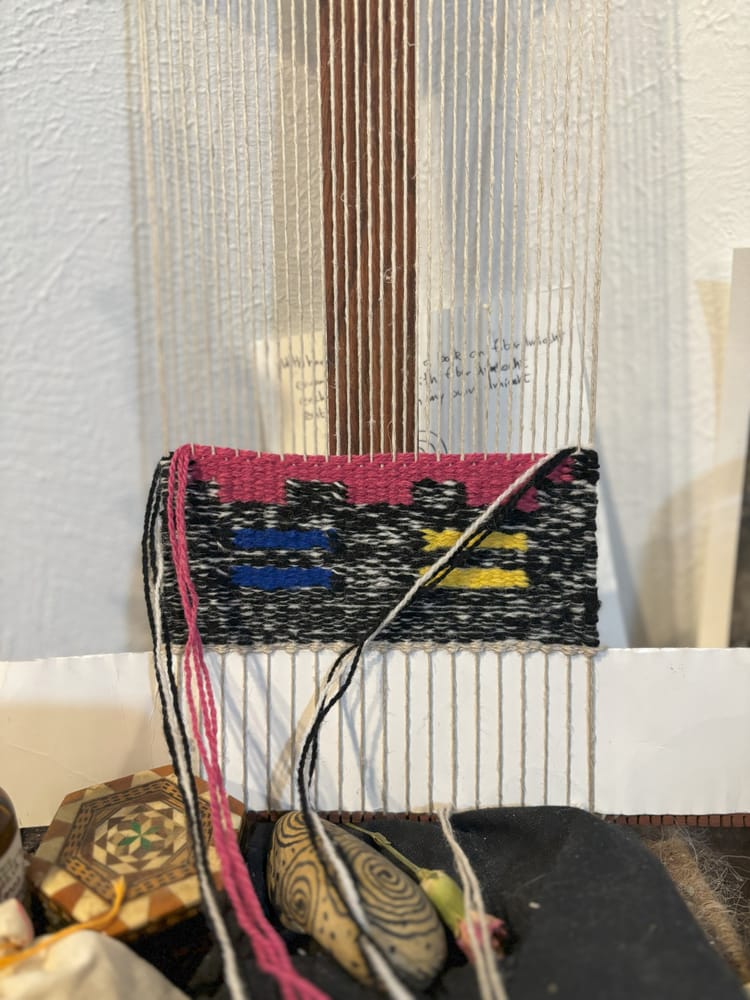
This piece was woven using all my own handspun shetland, spun on a drop spindle from fiber procured from two Colorado ranches: Piñon Woods Ranch and Dyer’s Wool. I naturally dyed white yarn with dried stinging nettle leaf to create the sandy yellow boundaries and dyed white yarn with calendula and coreopsis from my garden to create the vibrant orange surrounding the creative pathway at the center of the piece. The braided pathway at the center of the piece is made of ten-ply organic hemp twine. The braids have a staggered beginning in the warp to give the flow an organic, human feel to it.
The number three is the creative principle behind much of the design work here. This is a nod to the Irish Wisdom Tradition and the importance of triads. Two of my goddesses that I honor each day show up as triads, Brighid and Morrigan. Consequently, there is a deep divinity to building towers as Triads and inviting the Morrigan to strengthen them in a plume of Mugwort smoke. Well before there was the father, son, and holy spirit of my forced indoctrination into the catholic church, there was Brighid’s maiden, mother, and Cailleach forms, her patronage of poesy, healing, and the forge. I honor that deeper lineage with my three sets of towers, the three warp strings that each new braid of our braided pathway embrace as it traverses the warp from left to right, and the three key movements in the weaving. This might be understood as the numerological foundation of the piece—something that is more visible than the spell work, but still difficult to perceive unless you are looking for it.
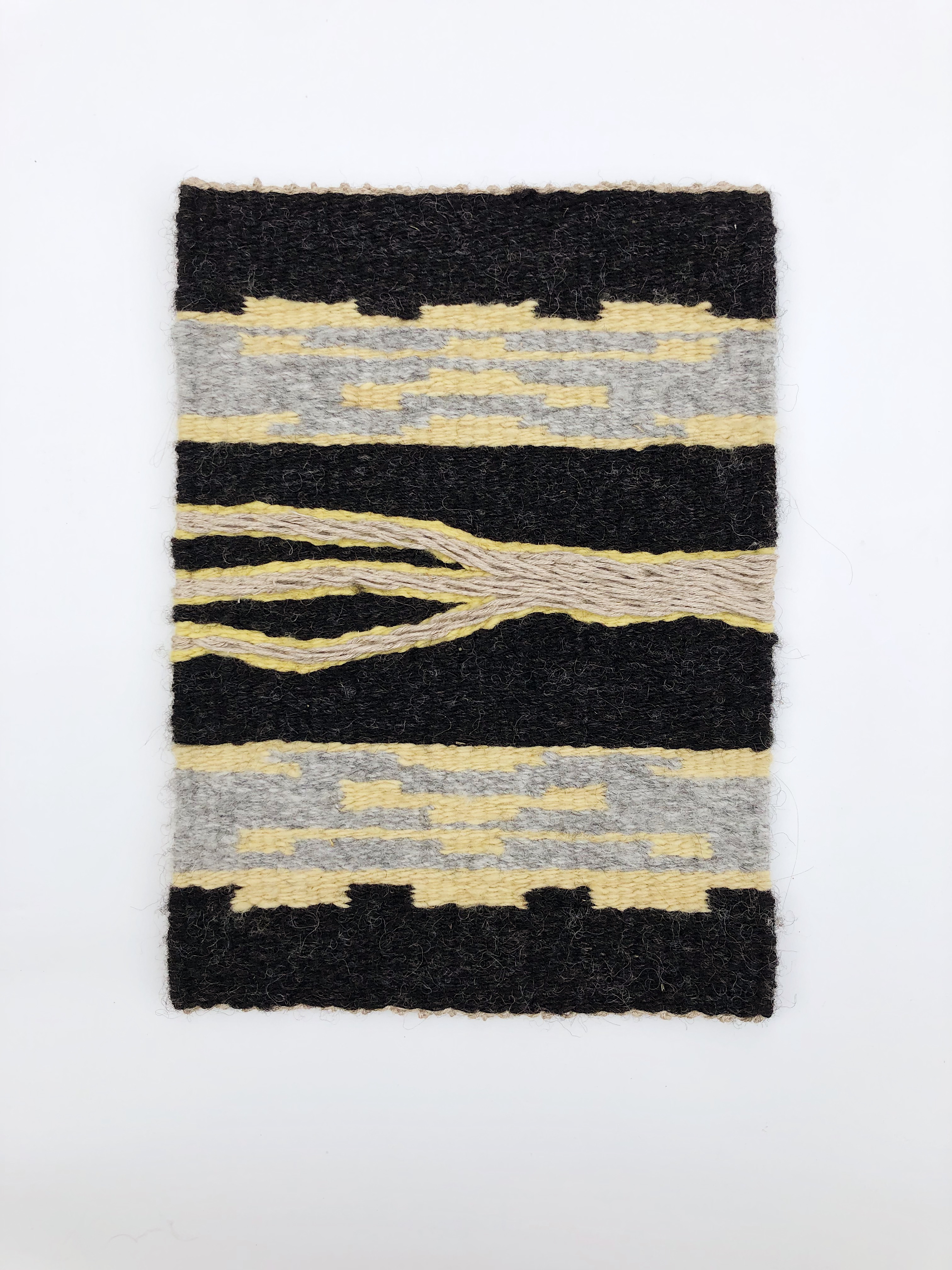
With another protection weaving complete, I feel compelled to discuss the philosophy behind this refined set of boundaries I set into this piece. When one looks back to my last piece “May this Pathway be Protected,” you see that I really went for it in my boundaries by trying to create a labyrinth-esq design where one who wished the recipient of this weaving harm would lose themselves in a mist of distraction and confusion. Here, I moved away from the labyrinth and brought in a medieval mace-inspired symbol into the middle of the boundaries. The intention behind this symbol was to use a symbol that would ward off those who might be inclined to encroach and be more in tune with how the stinging nettle would respond to the encroachment: with an irritant that would inflict a cost onto the person overstepping the recipient’s boundaries. This is the drama or the theater of the boundary and protection magic that is built into this piece.
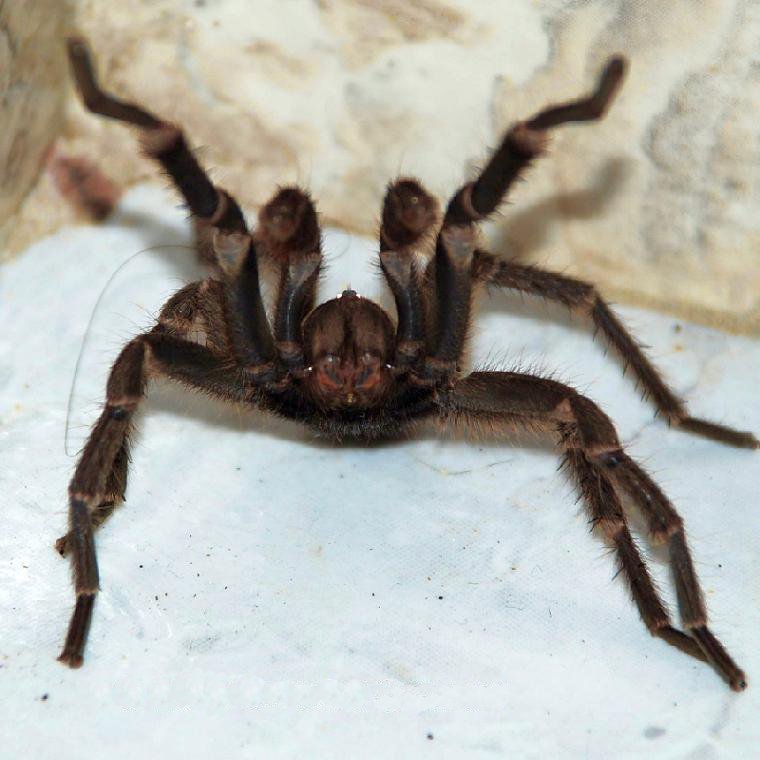
This protection magic is much like the deimatic behavior of our animal kin. Animals or insects that lack strong defenses or minimal toxic defenses have adapted to survive predation by developing their own tool kit of intimidating behaviors to frighten would-be predators. One of my spider kin, the tarantula, will rear up on its back legs and show its fangs when provoked by a predator.
The boundaries in this piece are no different. The stinging nettle is a mild irritant, but the real power is in the explicit boundaries shown in this piece. They comprise the majority of the composition and pale in comparison to our depiction of the creative pathway. This is on purpose. The boundaries of this piece are a play of enchanted theatrics to lose a would be predator in a mist of fog and provide ample opportunity for evasion. Should they persist, the stinging nettle levies a cost upon the predator, enough to thwart their attempt and instill a deep respect for the recipients boundaries.
This sort of boundary magic is a joy to make for me. It calls me to be creative in producing magic that calls for respect but does not do profound harm to others. It is a true magic of the hedge dweller where the clever use of herbs, words, and hands can make the difference between a good and very bad day for someone else. It is the mundane magic that helps me protect people in their abundance and creativity. That is a great calling in life. To be the simple enchanted builder who erects walls around people’s sense of their own worth and well being, who aids in erecting the walls that shield them from cold and marauders (emotional or otherwise).
Honestly, its not surprising this is my most requested trade item right now, especially of folks who interact with the public a lot. Our society today is full of marauders who run from person to person trying to prey on their attention, emotional energy, and time. Those folks who deal most directly with the public in their work are at disproportionate risk of falling prey to one of their raids. The marauders come ripping through the world with their sharp words and haughty demands. It is with great pleasure that I build enchanted implements to thwart their work and reduce them to fear. I hope all the recipients of such work from me find them to be most useful in throwing off the yoke of such tiny tyrants.
Thanks for reading A Quiet Practice! Subscribe for free to receive new posts and support my work.
My therapist and I were discussing my hermit’s path and I sort of lapsed into this discussion of how I plan to return to the world eventually. As per usual, she had a parsimonious, probing question for me. “Why do you feel that you need to return?” she asked.
I replied, “Well, I would hope that I could go back and continue the fight to make the world a better place.”
“Have I talked with you about the concept of hope?” she replied.
“No, I don’t think so,” I said.
“Well, hope is one of those concepts that can stop us from fully realizing that something is gone or dead. It can stop us from moving on.” She explained.
Little lights lit up all over in my brain. It became clear to me that my embrace of the hermit’s path is partly built on the recognition that so much of our old way of living is dead and gone. The pandemic was a rupture that cannot be undone. Having a child in a pandemic that was born not breathing after days of labor was a rupture that cannot be undone. The indignities and humiliations that I have faced in the modern American workplace in an international pandemic were a rupture that cannot be undone. Those experiences killed my belief that I could really define myself as the public sociologist that did public policy work to better society.
I have been stepped on and kicked so many times in my professional life that I am pondering whether there is any use in putting any more time and energy into the pursuit of public institutional social change. The last 18 years of my life I have been using my sociological tool kit within established institutions (academia, private sector, public sector) to try and push our society towards equity, redistribution, and restorative justice. I am shocked to see, as I write this, that this is half of my life. Yet, working in the trenches, I have found a lot to be cynical about. I have found a lot to be disheartened about. I have seen my dreams die right in front of me in an acid bath of lies, inertia, and a lack of political will (courage). So, here I find myself at the hermit’s door pondering the use of returning to that work with any real vigor. I could just continue to walk on as the “far out elder”1 who lives on the hedge separate from society at large.
For those dear readers who follow this project religiously, this is the milieu I found myself in during our recent essay The Hermit, Part 2, in which we talked about moving away from society in order to ride out the storm. Yes, heart break can make you recoil from people, especially groups of people. In response to the gentle prodding of my therapist, I want to make a further distinction in my own way I walk a hermit’s path. I choose to be separate from society as a means of protection for my own lifeway which is at odds with conventional practice today. However, I do not mean this separation to be a statement that I am forsaking my stake in society and my kin across the globe. No, I just choose to stand apart so that my voice can come from a different place. I am still very much interested in being of use and help to others. I just cannot do it with the same blind hope in the vehicles that have been offered me since I was a child. Yes, I choose to stand apart so I can clearly wield the literary sword of prose in service of emancipation of all those people experiencing oppression at the hands of a fanatical right wing fascism in our country. I choose to stand apart so I can direct my scorn at those who drape their oppression of others in a shroud of sanctity. Unlike the dude, I do not abide.2 I am actively engaged in working on and with the flow on the hedge while I work toward my own dream life.
As the hermit, I have replaced my hope with dreams of the world that I want to inhabit. Those dreams are much smaller than when I, you know the typical white male CAPITAL I, hoped I would change the world. I let that I, that hope die in the churning fires of the brush fires that surround us now. Yet, somehow in their absence, the dreams are so much more open-ended and sustaining. There is the manageable utopia of living the enchantment of a value-aligned life. There is the joy of wielding the sword and cutting off those who have harmed me and my beloveds from my life. There is the contentment in spending days upon days making with my hands, my head empty of significant thought, uttering spells into the nooks and crannies between wefts. There is the contentment in weaving words that 232 of you have decided have some worth, some use to you. What need do you have for hope with such embodied dreams at your finger tips? What need do you have for hope with such a life? You have not a need for it at all.
Thanks for reading A Quiet Practice! Subscribe for free to receive new posts and support my work.
Jessica Dore’s words not mine. ↩
Please indulge me while I point out how I am a bit different from The Dude from the Big Lebowski. This is just a silly point to differentiate my ideas of magic from the pervasive form of westernized zen we see in our culture. TBH, this move still is great. I am just feelin’ myself right now and in the flow. ↩
Member discussion