
Enchanting Your Fiber Arts Practice: Spiraling Spell Work for Warping and Weaving
Two weeks ago, we started our exploration of spell work for fiber arts with the first in a three part series. We described the rituals that I use for cleansing and preparing a loom. We talked about the herbcraft, ritual, and spells one could use to bring a weaving out of its barren, earth-bound home of winter into its renewal in spring. I explained the elemental magic that we divinatory-focused fiber artists could use within an ancestrally-grounded Irish practice to achieve such an end. As I am wont to do, I used the description of my own practice as a call to magic, a will to magic if you will, to inspire you to take up your own divinatory practice with fiber. I ended with some smaller actions that one could do to begin the initial work of bringing that magic alive in your practice. That piece is available to read here. Today, I present part two in that three part series.
Grounding The Spell Work
This week we are stepping our of the icy grips of winter we traversed last week and are focused on inviting in the renewal and growth of spring and summer with our loom. With the spell work for warping and weaving, we find ourselves grounded in a microcosmic movement that reflects our greater yearly movement from the spring equinox to the Lughnasadh, a stretch of time where we traverse the entirety of the growth period of our wheel of the year to the beginning of harvest time. For with the opening of a portal via warping and making that portal concrete with weaving in the weft, we are but like the humble farmers or gardeners who go to their plot each day to tend to their plant kin. Like all those who tend to the earth, our work with warping and weaving is embedded within the same spiralic dance of life that is so vibrantly alive to our senses in this period of the year. Yes, it is our job as tenders of the loom during these seasons to ensure it is a fertile womb for the opening and growth of a portal that can serve its role within our broader fiber spell.
Within these seasons of the loom, the ornate, necromantic rites that were required to awaken the loom from its dark, winter slumber are abandoned for the simple, simmering sweat that accompanies the industrious repetitions of iterative handwork. In the spring and summer of warping and weaving, we will be spiraling, spiraling, spiraling around through the hundreds of iterations that must be complete to bring our symbol/sigil into its new woven form. What else is our work on this plane? For are we are not just simple spiralic beings, made of spirals and working with spirals. Just like the orb weaver who spirals round and round its spokes when finishing its web, we textile artists spiral endlessly in our work, repeating these simple loops, knots, and weaves.
The warp is nothing but a gigantic ascending spiral that climbs from its origin in the darkness on the left hand of the loom to the right side. The weft, too, is no different. It winds its way over-under, over-under, over-under the warp threads, rendering visible a sigil from its spiraling ascent from its earthen foundation at the bottom of the loom to the far reaches of the firmament at the top of the loom.
Yes, dear reader, our magical act of creation is nothing short of a miracle, the stuff of great folkloric tales of old. With our hands, we bring into being that which was just of the realm of the invisible, the imagination. While weaving, we are not unlike the great goddesses Brighid in her popular magical textile story Brighid’s cloak.

Yes, while we build our own magic cloth, we wield the great talismanic power of the spiral, like any ancient craft creator. We stand at the threshold between this realm and the realm of the ancestors, plucking little sigils of the infinite from their collective dreams (the Otherworld) to be rendered visible into sigils for this realm.
Lesser and Greater Rites in Fiber Art Spell Work
Before we travel along our journey, it is best to describe how our spells for warping and weaving differ from those presented in our Spell Work for Beginnings essay. In our first essay in this series, we described the ornate, necromantic spell work, elemental magic, and herb allies that one can use to cleanse, heal, and awaken a loom to its new work. This personal ritual that I shared with you can be best understood as what Sylvia Eden describes in her Occult Needlecraft text as greater rites. Greater rites are those “more elaborate or involved” rituals, “best completed in one sitting,” that are “performed at an auspicious time, in accordance with the Will of the Craft; be that when the moon is dark or full, branches full or empty, Diurnally or Nocturnally.” They are the sort of rites where we bring our tools and fiber art into a sacred circle for some consequential act of magic that demands the pomp and circumstance of a formalized approach or ceremony. We will revisit another greater rite in our final spell work post when we harvest our weaving and bless and bind it.
However, not all spell work needs completed within a ceremony or sacred circle. Yes, there are everyday forms of magic that go uttered along with completing repetitive or daily tasks. In this, we are thinking of what Eden described in Occult Needlecraft as lesser rites, those more common ritualized actions of magic, such as offerings to deities in our altar magic practices; words of thanks for food and health; or the repetitive handwork of stitching, spinning, or weaving. Lesser rites are those ritualized handcrafts that are “better suited for projects that may need multiple … sittings,” which describes the bulk of our time-consuming weaving work. These are the forms of magic that build in intensity with the length of time a person devotes to their practice. Lesser rite work can build is own devotional intensity as the magic imbued into the cloth builds over each spiraling iteration. It eventually rises to a similar level of intensity as that built through a greater rite.
In line with Eden’s guidance in Occult Needlecraft, a key part of developing your handcrafts into a lesser right is developing your spell and sigil word that you will chant along with each layering of a pick of weft. Within these lesser rites, Eden recommends “distilling a sentence (spell)…, which clearly states the desire effect/outcome of the craft, …into a single word (sigil) to be spoken aloud,” with each loop of a warp thread or laying of a pick of weft into your work. Within my own practice, I like to utter the longer spell for the weaving as I begin work for the day and then move on to the sigil for each of the picks and rows within the weaving. For example, if I was weaving a protection symbol, I could start by saying, “With this weaving, I surround the person in a protective boundary.” I could then utter the word, “protect,” for all future woven picks. I will show another example of this below in the journey section when we discuss my spell and sigil words for the current piece I am working on.
Spiraling round and round with sigil words in handcrafts can bring up opportunities for improvisation. Don’t be surprised if during the course of your handwork that something reaches back with a suggestion for alteration. This is probably my favorite type of magic that comes out of this sort of practice. You will find yourself happily working like a little busy bee conducting your handwork in line with your sigil word and all of a sudden, WHAMO, you are gifted a new little thought. It could be the bigger purpose of the piece, a sort of orienting phrase or title. It could be a new design element that you will want to incorporate. It could even be a new sigil word that you can use in certain parts of the weaving or you could alternate it with your original sigil. Regardless of the message, heed it for it is an opportunity to collaborate with the ancestors by remaining open to improvise based on their feedback during our magic workings.

Such moments of improvisation are part of the natural giving and receiving that occurs when you approach your divinatory fiber arts practices through a Spiral Theory approach. Jen Murphy of the Celtic School of Embodiment recently noted that she has been “developing a way of working called Spiral Theory to ensure that her working day his an evolution of receiving and giving, anchored in pleasure.” She then went on to describe how incorporating various receiving practices, such as sitting in a sacred site and engaging in women’s collectives, into her work day helped her approach her teaching and coaching with more “intention, quality, and magnetism.” In approaching our weaving practices as a sacred, spiralic act of magic, we are entering that dynamic space of moving between both giving and receiving in the course of our work. As we spiral around and around with our weaving and spell work, we are cultivating that deeper connection to the sacred which allows those moments of improvised inspiration to come through and deepen our work while we are giving so much of ourselves. It’s that generative spiral theory space, my invisible divine compass, that has propelled my work in the most interesting directions over these last five years.
The Journey
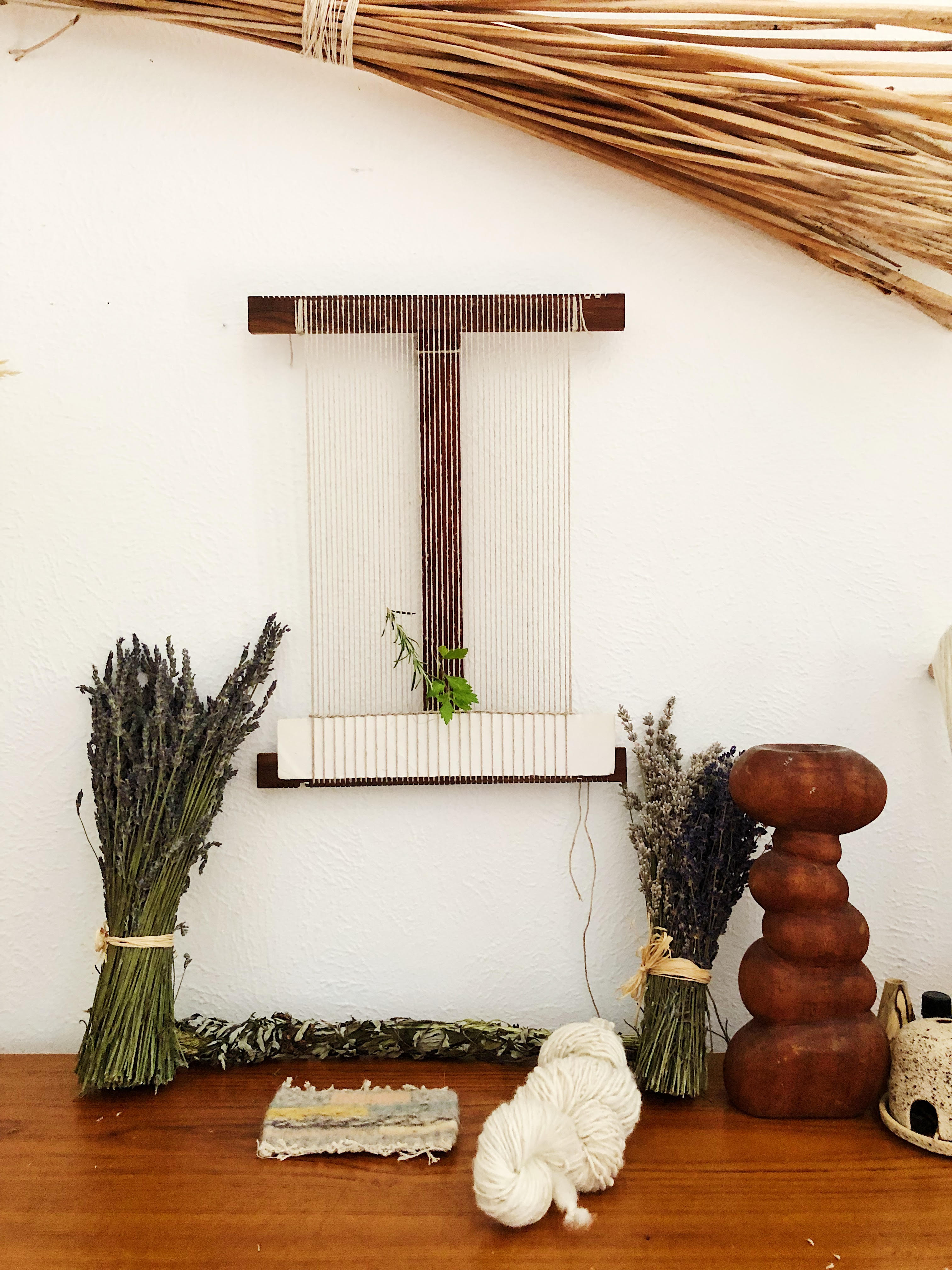
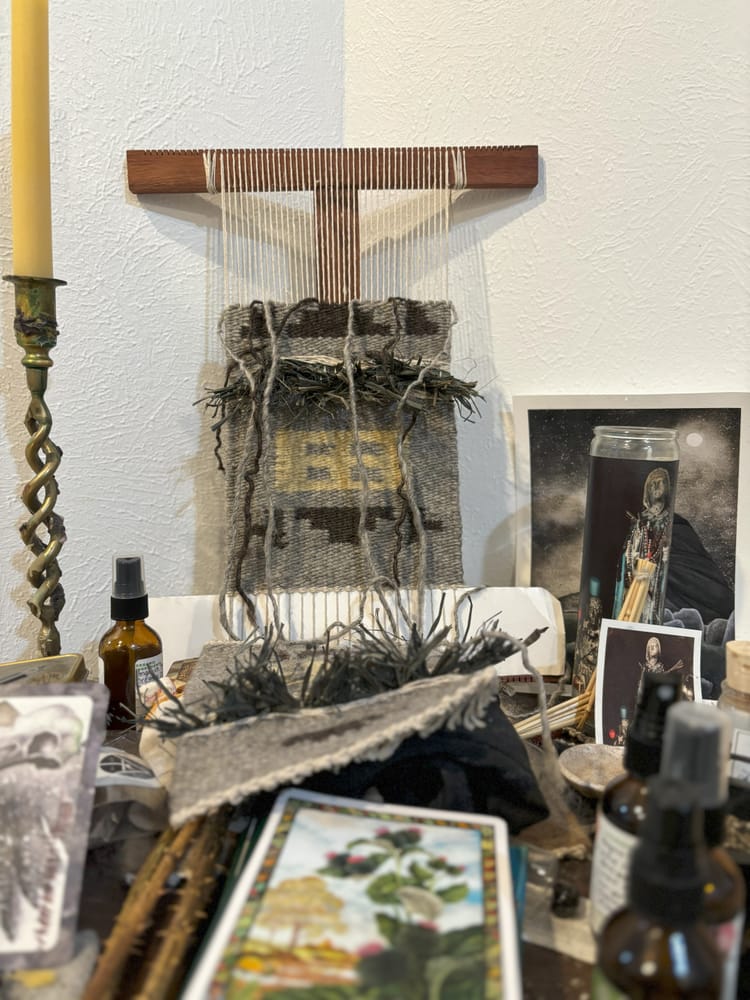
I took a deep breath and lit a candle on my alter. I sprayed my grounding and clearing spray in three directions and swirled the mist in protective circle. I filled the basin of rosewater and anointed my Brighid candle, my mom’s ashes, and my Morrigan beads. I placed a little rose water on the nape of my neck and sat back in my chair. Holding my loom in my hands and my hemp warp thread in the other, I looked intently at the empty loom. I quietly uttered, “With this warping, a new portal to rebirth opens.” I wrapped the 6-ply hemp twine around the top beam and firmly threaded the twine to the lower beam. As I wrapped the hemp around the notch on the bottom beam, I intoned, “Opening the portal.” I pulled the hemp twine up firmly wrapping and notching it on the top beam, chanting, “Opening the portal.”
Again and again, we repeated this process, uttering our spell in rhythm with our hand work.
“Opening the Portal.”
“Opening the Portal.”
“Opening the Portal,” I repeated with each notching of the warping process until a nine inch stretch of the loom had been prepared. On the last strand, I cut the warp thread from the ball of hemp twine and wrapped it around the top beam to secure it. Upon closing the warping process, I said, “With this warping complete, a new rebirth portal is opened.” In my minds eye, I could see a pathway extending back out of the piece, leading to another dimension in the land of my ancestors.
I placed the loom on my altar and let it rest. It will need to be on sacred space while it is on its journey to becoming. This rest my be for a few minutes, few days, or few weeks. It is no matter the length of the rest time. All things in the universe conspire to give the loom precisely the length of time it needs to rest. All that matters now is that we have successfully opened our portal and are ready to render visible the sigils and symbols on this side of the portal.
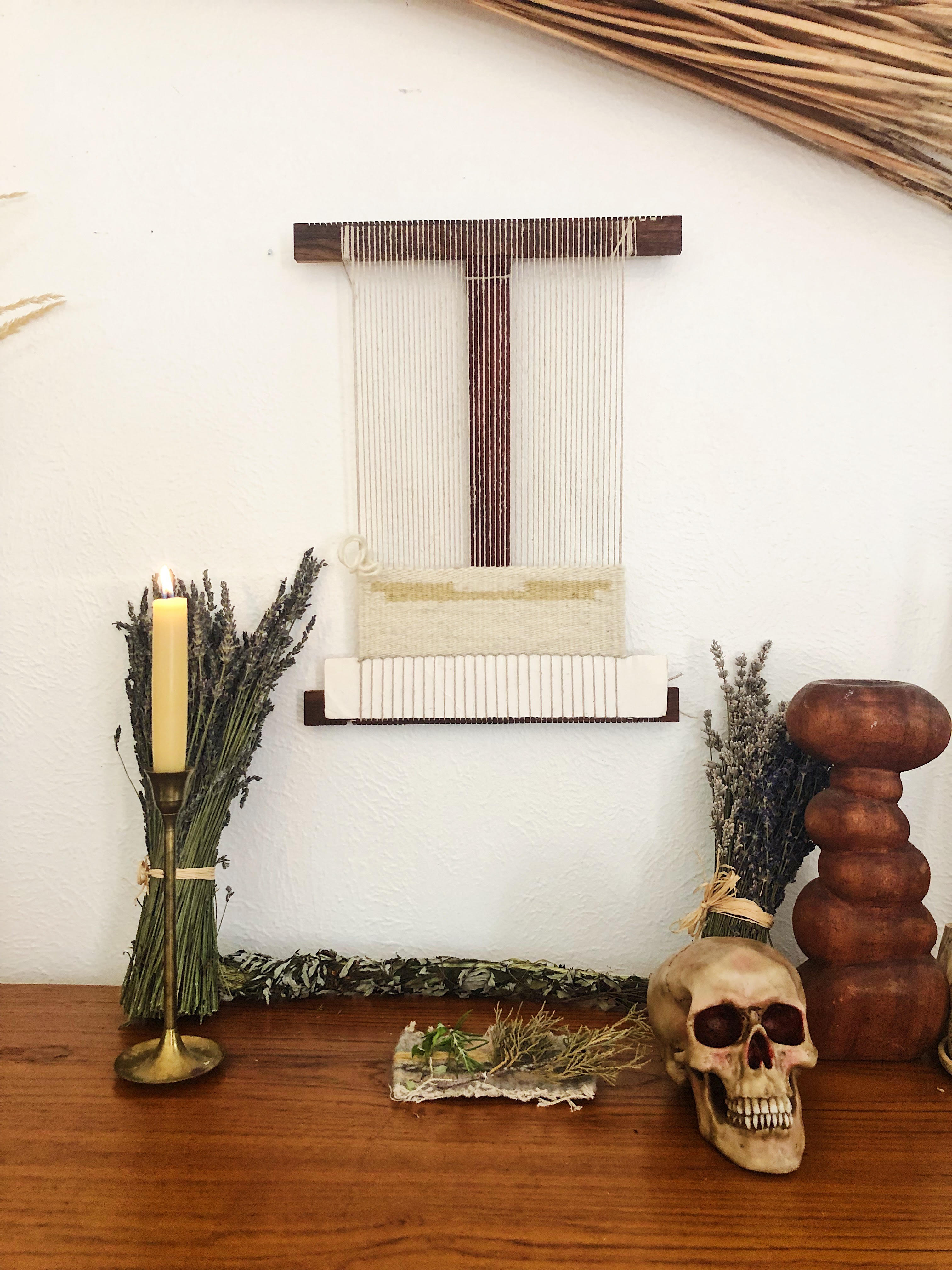
I picked up my loom off the altar and took a deep breath. I let my exhale take away all the extra roles I play in society. For a moment, I am not researcher, writer, citizen, partner, or father. I am just a simple hermetic fiber druid, stealing away a few moments to ply his craft of fiber magic. I am not of the world. I stand apart from it to connect to the deeper rhythm of Nwyfre, divine life force current, that all us druids connect with in their mystical wanderings.
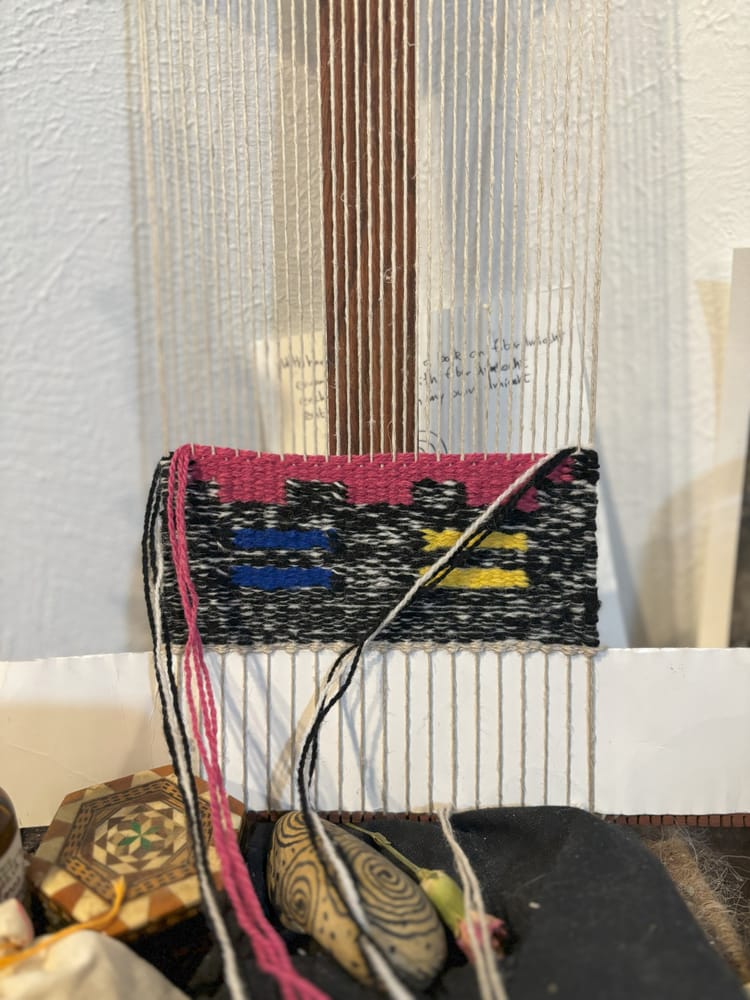
I took my shed stick and opened up the first shed. I paused, took a deep breath in, let the divine light inside myself gather at my left shoulder, and extended my left hand toward the open shed. I exhaled and let the radiant white light travel down through my portal tattoos and into the shed space. While the light filled that shed space, I whispered,
“With this weaving, we pour our own divine inner light and the light of our trifold sacred circle into this portal to render it visible.”
I packed down the weft with my beater and readied myself to begin the rhythm again.
With my shed stick, weft, and beater in hand, I repeated this ancient mystical rhythm. I ran the shed stick over-under-over-under the warp threads until it reached the other selvedge edge of the tapestry. With the shed open, I extended my hand again and chanted, “Pour our Light,” as the light of my circle illuminated the space where the weft rested. I placed the weft into the shed and beat it down. I continued again and again with my fiber rites:
“Pour our light.”
“Pour our light.”
“Pour our light,” I repeated again and again as each bit of weft was laid to rest, rendering our sacred pattern and symbols into its corporeal form. The solemn, quiet rhythm invigorated and calmed me as I went about the simple task of bringing something into being that was once invisible.
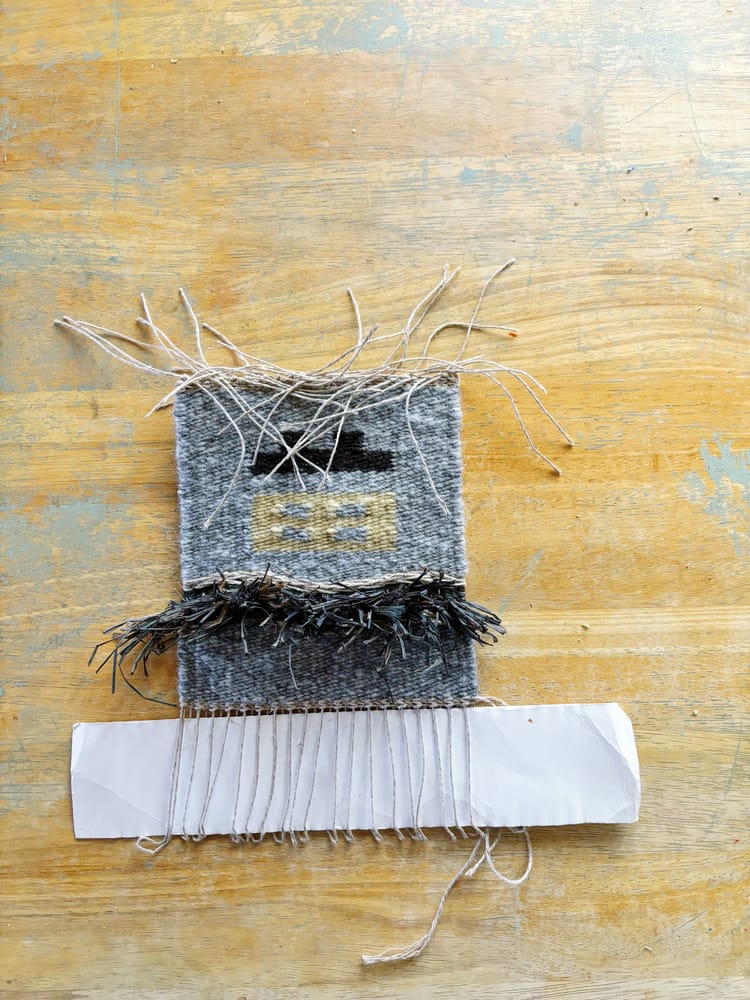
Then, ALL IN A FLASH, something spoke back from the Otherworld. “May you be protected in your Joy,” I heard my voice utter silently inside. I recognized the voice as my own but knew this message was from my ancestors. Through my Spiral Theory approach to weaving in sacred circle, I was not just giving of myself through my craft, but also open to whatever messages from the ancestors that may be shared. Taking heed of this message, I recited, “protect,” with the weaving of certain pertinent sections of the stinging-nettle-dyed weft that would make up our boundary. I then wove back and forth between my two incantatory phrases, filling the textile up with divine light and protection for Heather.
This textile is yet to be complete, but when complete, we will close our weaving process with a closing spell similar to the one we ended our warping process with.
“With the weaving complete, the symbols are now visible and our portal can be closed.”
This portion of the spell will begin the process of binding the cloth off from its connection to the otherworld so that it can be cut off the loom in its fullest magic and sent to Heather for her home. There will be more about that in part three of this spell work series. Here we find ourselves at the end of the weaving process standing on the threshold to the harvest season. We are ready to harvest our magic textile off its loom and bind and bless it in a final great rite of necromancy, evoking the great power of our celebration of Samhain as a guide.
Now, here I must pause, how are these spell work posts landing for you? Is there something you particularly like about the posts? Is there anything you have started to build into your own practices? Is there anything you would like me to change? please do let me know via email or comment below. I have poured myself into these two spell work posts, so I would love to know y’alls thoughts and feelings about them. Thanks to those who have already let me know their thoughts on the series. I so appreciate it.
Until next week,
James
Thanks for reading A Quiet Practice! Subscribe for free to receive new posts and support my work.
Like capitalist, christian patriarchy, king is not a proper noun and won’t be in this project. kings and queens are not celebrated; they are an obstacle to be overcome on the pathway to human emancipation. ↩
Member discussion