
Think of Death as a Friend
Most everything bit of wisdom I hold has come from death. It’s a morbid thing to say in our culture, but that doesn’t negate its truth. I have sat on my deathbed countless times as I have watched parts of myself die away. Many parts of myself that have died away—ignorance, hope, biased views—had to die for me to be the person I am today. You can’t become a traitor to your privilege without burying the ignorance and bias you are born into in a shallow, unmarked grave and leaving it behind to rot in eternity. There is no solidarity with the people you want as kin without the death of the connective ties to people perpetuating our unequal world.
As I built myself into a sociologist, I would read with glee of all the social facts that dispelled the idiotic myths that are piped down our throats from the jump like so much hot garbage. No, just as I had assumed, hard work does not always payoff with upward mobility in the United States, so keep those bootstraps in storage. In a recent Guardian article, Social scientists Mark Rank and Lawrence Eppard noted, “What about rising from rags to riches? In the US, 8% of children raised in the bottom 20% of the income distribution are able to climb to the top 20% as adults, while the figure in Denmark is nearly double at 15%.”2 I couldn’t have been happier to let the famous Horatio Alger American myth die, so that I could find my own origin stories to latch onto. The sort of stories that tell of the sort of solidarity, magic, and autonomy that is as American as apple pie.
Yes, sociologist have also displayed that they are a good friend to death. Emile Durkheim wrote one of the foundational texts of the field in 1897 when he tried to explain suicide as a result of a lack of connective ties to religion and family. Sociologists may spend less time explaining death now, but are still quite focused on explaining more macabre topics like genocide, inequality, and discrimination. That’s the sociology I am immersed in; the sociology devoted to explaining how an incredible world of suffering could be created for the benefit of the few. The decision to focus on documenting the darkness and explaining how and why it happens is the strength of sociology. It doesn’t reach for the easy solution that will let in a ray of light. No, it drowns you in the immensity of the problem, trying to show you how serious and grave the problem truly is.
That ability to stay with the darkness makes sociologists true societal death workers. Everything in our capitalist society wants to ignore or provide a quick fix for the darkness of death in its myriad forms. They want to stuff death in the back of a drawer or closet and forget it ever exists. The sociologist is often critiqued for not providing the fast solution to the darkness of the worlds problems, to play a role in maintaining the theatre of rending death invisible. However, what if we just let the sociologists be our death workers chronicling and being with our society’s darkest realities? Yes, let us do just that and sit with that darkness for a while without just trying to ignore it. Let our sociologists be our societal death workers who draw attention to the “typically invisible shroud of grief that cloak sites of public tragedies” or the reality of our collective human suffering. (If interested, I wrote a longer form article about societal death work that you can read here.)
It’s truly one of my life’s oddest journeys to keep tracing the tendrils of my friendship with death. Even when I wouldn’t admit I was friends with death, I was walking the path of the death walker straight into the furnaces of the deepest moments of hell that humans can conjure. Yeah, I wrote an entire master’s thesis on how the US government justified moving the Cherokee tribe at gunpoint in the dead of winter to Oklahoma in 1839. Yes, I have documented racial and gender hatred in government reports to detail the discrimination that still plagues our society. Yes, I have summarized actions in technical reports that recount the tragedies of people losing their lives in the most inhumane and terrible circumstances. I have always tried to get others to see that darkness.
Sometimes I try to think about how I became this person. I try to think about what has driven me to this place of being the shrouded one who keeps to the shadows and whispers of phantoms. I has always had this nagging need to shake people loose into this same wide-eyed awareness of the pain and tragedy of this world. I remember Somnambulance (sleepwalking), my first newsletter I ever created in college. I wrote naive, romantic notes on the depravity of the power elite (C. Wright Mills) and the inhumanity of inequality, hoping to throttle the idiots at my school trying to get internships at Disney or with Republican senator Richard Luger of Indiana. Not much has changed I suppose. I still am reading and writing about the dark stuff hoping to have a similar effect. I want to shake you out of the routine to embrace this inevitable decay that we all must face as humans. That’s what the darkness is all about: a noticing of the rot and decrepit corners of our existence in this year of our viral overlord 2023.
The death of empire is not lamentable; It is to be celebrated just like I celebrated the loss of my ignorance. If we have learned anything through the pandemic, it’s that we have been left on our own and the federal government has a diminished capacity to do much else but bail out predatory banks and pilot drones to drop bombs in faraway places. The fact that I was forced to pay taxes on the child care credit I was given by the Biden Administration is a farce. Yah, “Bucko,” let’s make sure parents pay up for the cash advance we got on childcare, so we can give Boeing more money for missiles. When the day comes, and I hope it comes soon, I will not let out any mournful dirges for the loss of American global hegemony, what Antonio Gramsci defined as a “process of ‘intellectual and moral leadership’ that embedded a ruling class across society.”3 No, I would be glad to see us close the 750 military bases we have worldwide, sink the warships and planes, and use that money to feed, cure, and educate people here and invest in the arts.4 I would be happy to see us turn off our beacon on the hill and just take care of people. I would celebrate the end of empire and the opening of a regime of care.
In the face of the hallowed out neoliberal hellscape, we do have the opportunity to create our own autonomous zones of mutual support and protection. I agree with Berardi that politics is broken in ways that are beyond repair.
Me, I still hold to the barricades against the never-ending barrages of fascism within the system, but I do spend the rest of my time dreaming of how to make use of the fertile soil left behind by the death of traditional forms of dissent. Like Berardi, I dream of creating spaces outside capitalism and neoliberal government institutions:
“Not political revolution but schismogenesis — a separation of part of society from the decaying body of capitalism. Creation and proliferation of autonomous communities, food self-sufficiency, self-defence against police, against the racists, and against the state. This is a strategy for survival and for reinvention, a strategy for healing the pyscho-sphere and the social mind.”
I dream of creating and working in autonomous zones where mysticism, mutual aid, barter, skill sharing, and group protection can create an alternative to the nilhilistic, death impulse of capitalism to grow at all costs. (counterhegemonies if you want to get all critical theory with it). You know why? Because I believe in our capacity as humans to create our own spaces where we can thrive, build, and take care of one another.
I, forever more, will honor the legacy of Mark Fisher by saying there is always an alternative to capitalism and the neoliberal storm we have been riding out for my entire life. This insistence on action despite the odds is my own knee-jerk reaction to my own domination in a system that tries to lull me to sleep into the nightmare of capitalist realism, what fisher described as “the widespread sense that not only is capitalism the only viable political and economic system, but also that it is now impossible even to imagine a coherent alternative to it.”6 It’s my own deep waking nightmare to believe that my only real freedom is to choose lucky charms or fruit loops. It’s my nightmare to have to embrace entrepreneurship as a vehicle for social change. It’s my nightmare to see people worshipping Elon Musk and other do-nothing billionaires. So, I persist in my own dogged attempts to model how we could build a different world and embrace death as my good friend. Because, through death, all things can be reborn anew and more equitable relations can sprout forth.
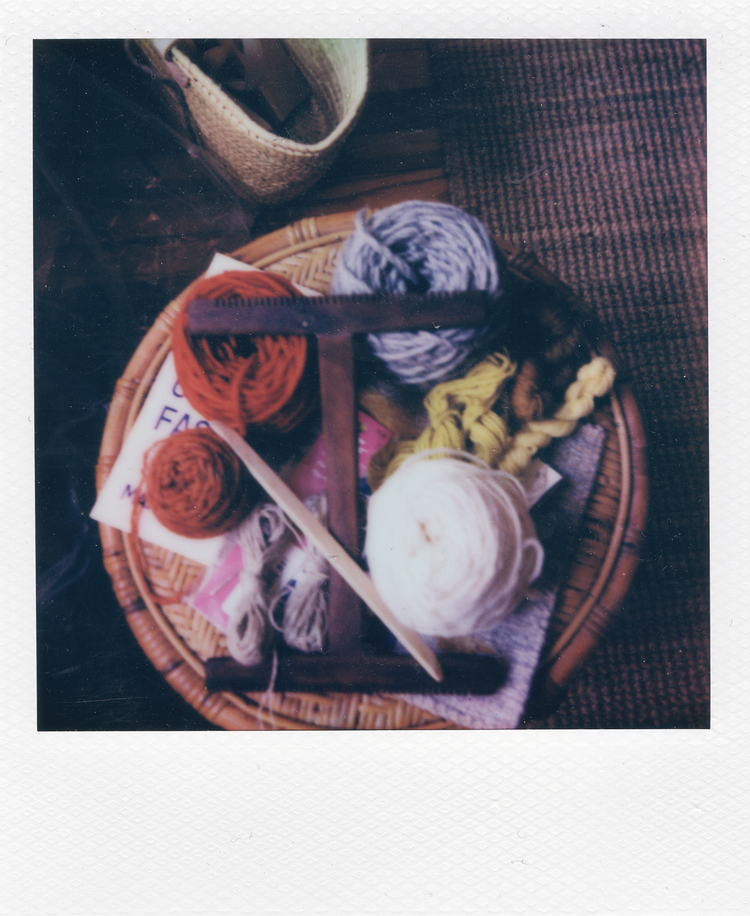
In the studio, I am working in spinning up a bunch of yarn for my next project, which will be a large format griefscape, a depiction of my own grief at a visceral scale. This includes blending my own ethereal grey from my black and light grey shetland fiber I have on hand. This will be a time consuming process to blend all these by hand with my carders, but I really don’t want to buy a drum carder. I just want to be with the simple, repetitive work that I have always enjoyed with the fiber arts. More photos and updates are forthcoming as I build up the first skein.
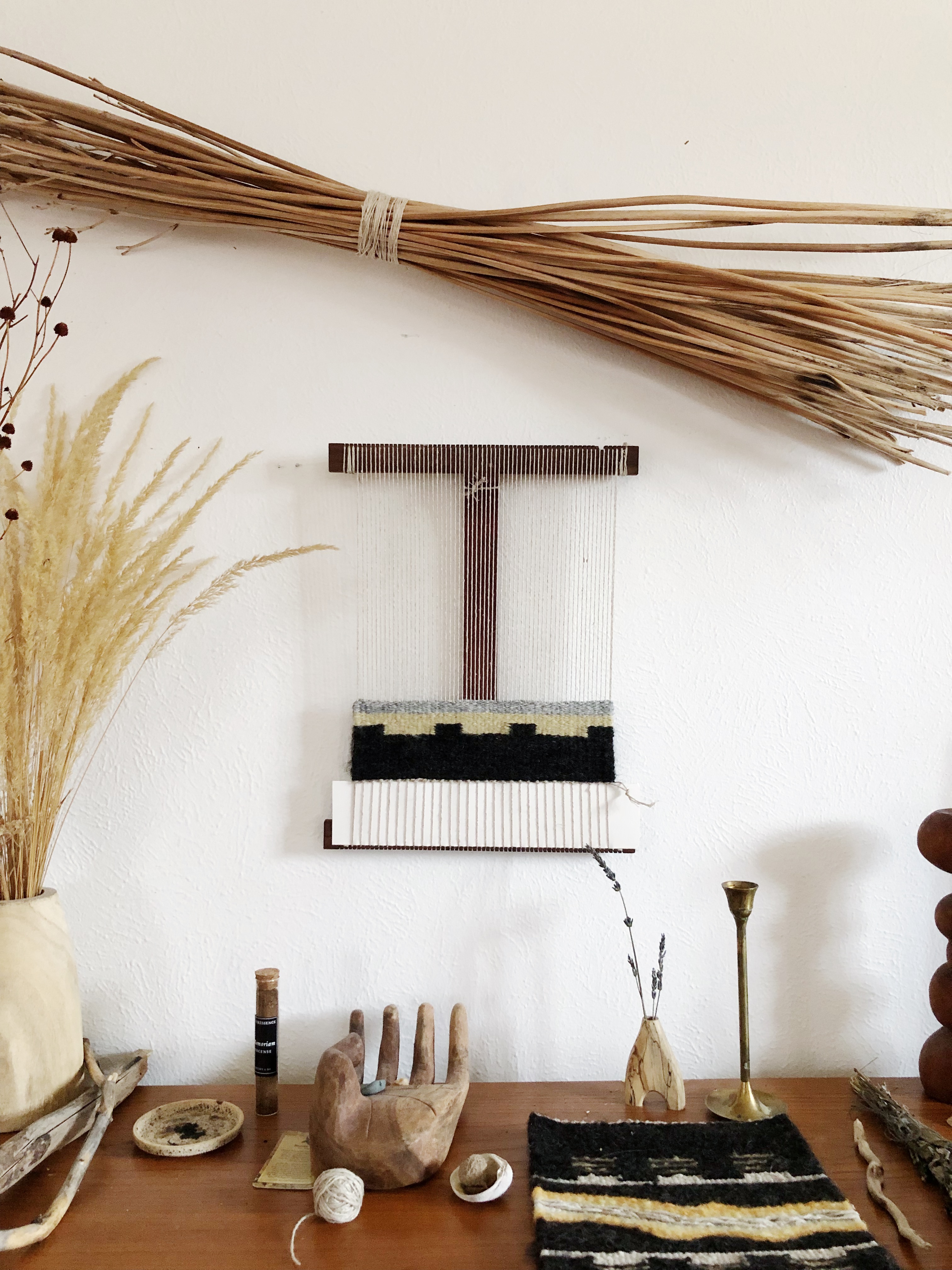
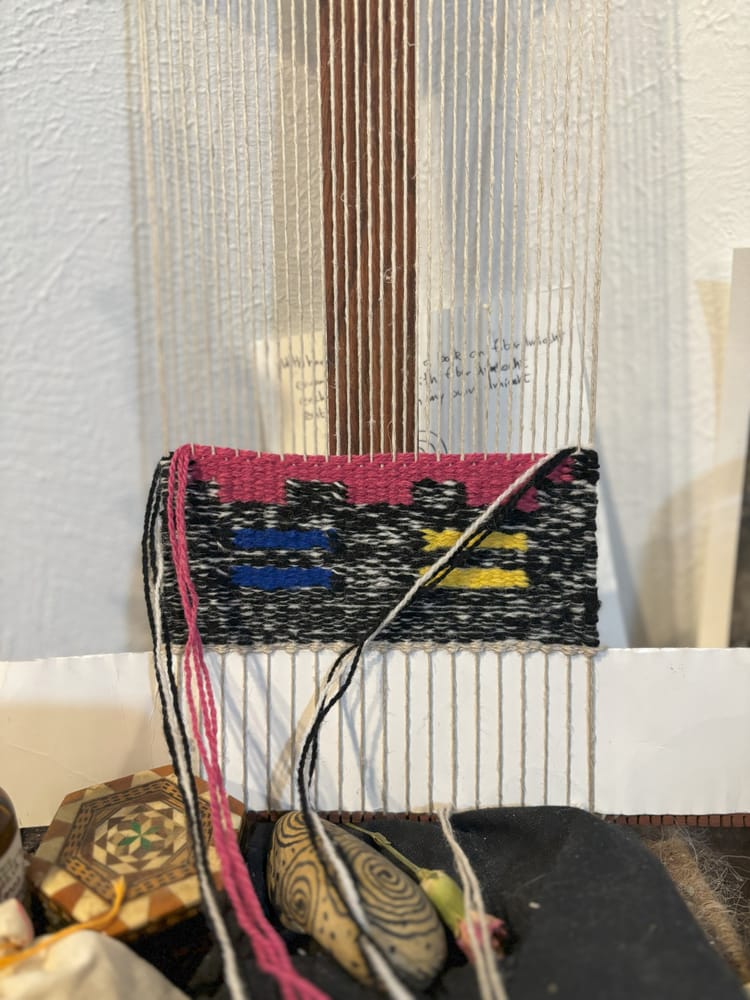
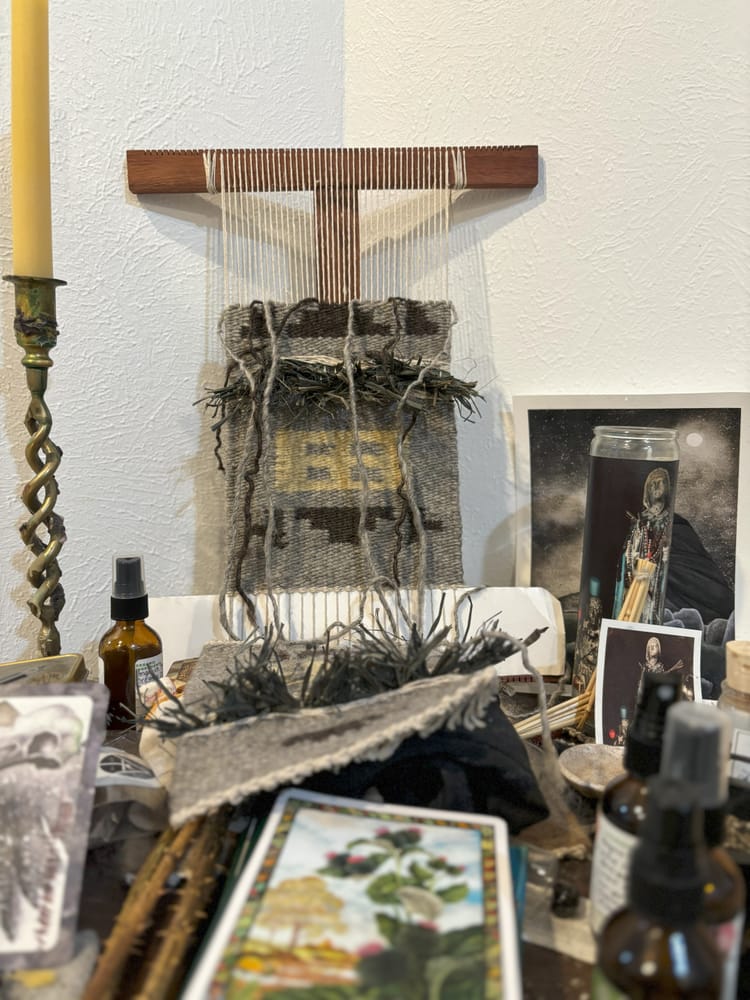
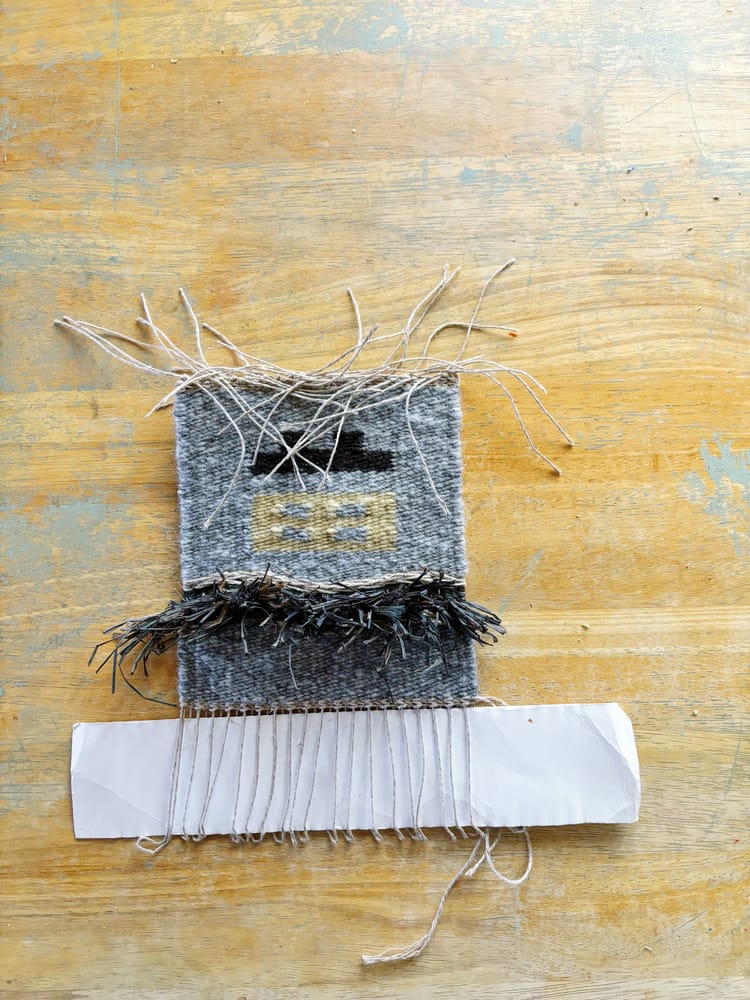
Also, I continue to work on my latest fiber spell (seen above). Here is where we were at a few days ago. I have been working steadily through the bottom boundary this week. I particularly like the boundary design that I decided upon. In the border of nettle-dyed fiber, there are three waves of columns that act a a 9-part buttress to anyone trying to interfere with the creative flow of the recipient’s smithwork practice. Yes, may those that seek to meddle be stuck in the irritation of the bite of the stinging nettle and find no comfort in their meddling, with harm to none.
I am approaching the middle creative flow section, which will be comprised of two flowing lines — one of rose-dyed yarn and the other of organic hemp twine. The rose-dyed yarn will be used to call in the help of Brighid, the patroness of smithwork, to bring sacred inspiration to the recipient’s practice. The organic hemp twine, as always, represents the person who is receiving the fiber spell. May Ryan’s practice be surrounded by the inspiration that only Brighid can bring to smithwork, with harm to none.
As always, all my best to you and your kin, dear reader,
James
Thanks for reading A Quiet Practice! Subscribe for free to receive new posts and support my work.
Berardi “The Third Unconscious” pg 116. ↩
Rank and Eppard, “The 'American Dream' of upward mobility is broken. Look at the numbers,” The Guardian, 03/13/21. ↩
David Vine Interview on Democracy Now, February 14, 2023
https://www.democracynow.org/2023/2/14/david_vine_us_bases_china_philippines#:~:text=The%20U.S.%20has%20about%20750,China%2C%20says%20researcher%20David%20Vine.) ↩
Berardi “The Third Unconscious” pg 145. ↩
Mark Fisher, Capitalist Realism: Is There No Alternative? , at 2. ↩
Member discussion