
When Magick Follows Death
“The thing you are most afraid to write. Write that,” Nayyirah Waheed counseled. Do you know how many moons it has taken to write of this death? Too many. Too many. Too long have I feared writing this story. It has hindered my rebirth to not write of the loss of my first love. I still remember smoldering with the fire of righteous indignation at the world sociology revealed to me, so grieving its loss has taken many years. I have been too scared of the judgment from employers. I fear they will cast me out into the darkness for speaking my own truth. Yet, I have reached the critical juncture where I can no longer remain silent for a new fire is smoldering in me. I have embraced and integrated the darkness within me and won’t shirk from the work I now have before me.
A Death in Three Acts
The man bruskly walked into my office on the 22nd floor of an office tower downtown. It was my first month on the job. I was still writing my dissertation in my spare time while working my first day job at a for-profit company. He walked over to an old desk leaning up against a bank of windows with a document in hand. “James, this is sloppy,” he said in a matter-of-fact tone. The words stung. I felt the pain deep in my heart. A second later, growing irritated by the judgment, I asked, “What about it is sloppy?” He pointed to a minor grammatical error in the first paragraph of a 50 page report. “We can’t have errors in our documents,” he said with a tone of finality as if he was passing down a commandment from on high. “Ok, but are there other errors in the document?” I asked. “I don’t know. I haven’t gotten to the rest of the document,” he retorted.
From the moment I entered the workforce, I was a cog in a machine, given no space to be human. Errors weren’t opportunities. Errors were fatal. Errors led to lawsuits. I choked down the feedback that I was sloppy and willed myself to be perfect. I wound myself up each morning like a mechanical toy, sending out invoices, supervising others’ work, and writing reports in as little time as possible. I was trained to explore, but I was chained to answer questions that only money would pay for.
The boss and I flew out in the morning in suits. We had a returning flight scheduled in the evening after completing the interview for the project, so we brought no change of clothes. We drove to the government department where we were interviewing for the project, arriving to a desolate brick building in a part of the city surrounded by grass and highways. Walking through the glass doors of the building, I looked around saw that it had not been largely changed since the 1970s. The lobby had brown tiled floors, brick walls, and posters noting current department initiatives. It looked like a space straight out of a past era of America. We checked in at security and they notified the interview committee we had arrived.
We were welcomed into a characterless meeting room with two sets of folding chairs and tables: one for the interrogators and one for the interviewees. We all exchanged greetings and readied ourselves to sit down. A woman in a business suit, the head of the committee, interjected with a sly smile, “You won’t be needing to sit down just yet. Let me explain our format. Each of you will be interviewed separately. We will ask you a series of 10 questions that you must answer in 20 minutes. We will record all of your answers and enter them into a computer program that is designed to compare your answers to your proposal. Who would like to go first?”
The boss and I decided he would go first, so I returned to the lobby to wait. I was brought as an aid to the presentation and not to answer key questions about our proposal. I felt the fear and anxiety of being partly responsible for winning work to keep their business going rise up in me. I took deep breaths, practicing techniques my therapist taught me to identify the emotions of fear and anxiety in the body. I suddenly had to go to the bathroom very badly, a common response of my body to extreme stress. After using the restroom, I patted water on my face and waited my turn with the interrogators.
I was welcomed into the featureless room and faced four people. The head of the committee explained the interview format again. “Ok, let’s begin,” she said and started a timer that rang out with a digital beep. The whole experience of answering the questions felt like an out of body experience. I felt like I was in a futuristic horror film that I didn’t know I was cast in. The questions were simple enough, but their surprise trap felt like torture. Inside I was all in knots, watching myself respond to the questions with ease. I finished answering all the questions with plenty of time to spare. They stopped the timer and thanked me for my time. I smile and thanked them for the opportunity—something I am ashamed of today. It’s an odd thing to thank your torturers.
The nightmare didn’t end. We left the department and got a coffee. While at the coffee shop, the ding of an incoming text message interrupted my billable hour work. “Your flight has been canceled,” the text said. I sunk in my chair, realizing that this hellish experience had gotten worse. We scrambled to find hotel rooms, competing with folx who were in town for some pyramid scheme sales conference. I had to wash my underwear in a sink that night. I was kept awake by the alcohol-drenched ramblings of conference attendees. We returned home safely the next morning, but found out months later that they had canceled the entire proposed project. The tortuous experience was all for nothing.
At each turn, I faced dehumanizing experiences in the work force. You want to advance social change in the cracks of bureaucracies in America? Well, be prepared to have yourself ground to a pulp. Be prepared to be humiliated. Be prepared to have individuals tell you that your own questions are meaningless.
I was new on the job and volunteered to help out a co-worker. I had changed jobs in the hopes that I still could love doing sociology for society’s benefit. The co-worker and I attended a private training for a task that I would be assisting them with. During the training, they abruptly interrupted the instructor, “he’s a sucker,” insinuating that I was easily duped for being willing to help. The instructor laughed nervously and continued. No less than two more times during the training they called me a sucker, chuckling while they did so. They didn’t want me to forget. I wasn’t the first person they harrassed on the job and wouldn’t be the last. The director of the office did nothing to stop this person.
The longer I spent in these jobs, the more dead I have felt inside. I have witnessed the life leave a loved one’s eyes, so I know the look of a light flickering out well. I could see my love of sociology being squeezed out of me by our rationalist, capitalist society. There is a unique cynicism and hopelessness that the curious type feels when learning that one only can answer questions that money will pay for or political games will allow. There is a drowning hollowness that the sensitive type feels when having one’s face rubbed in the dehumanizing reality of 21st century work. Yes, indeed, the light has gone out of my love for sociology. The flame has extinguished. Let out a rich lament. Let out a harsh howling keen. We have no one to blame but the hideous systems that we have created to turn the screws on ourselves. As Weber theorized in The Protestant Ethic and the Spirit of Capitalism, we have locked ourselves in the iron cage of rationality and thrown away the keys.1
The Memory Provides a Spark in the Darkness
“I could see the dark light surrounding him as I drove by, James,” my mom said, referencing a man she saw while driving home. “He doesn’t have long to live. He must be sick,” she continued. The house is dark. My mom and I are sitting in the dim illumination of a grey Ohio winter afternoon. The TV is off. The air was still. Time seemed to slow in the wake of her words. Particles of dust hung in the air like stars. Just a simple teenager, I sat and listened to the story, quietly absorbing what my mom had to share. Belief in her worldview was all I could muster. She had the power to bend any room to her favor, manipulate time with folk wisdom.
Little specks of memory like this are all I have of this magickal upbringing. The grief of not remembering more is palpable even today. Its heavy, weighing my heart down into my lungs heavy. Its black, molasses-thick sludge seeps out of the black hole in my heart left by her loss. “If I could just have asked more questions or shown more interest in what she was sharing,” I would think to myself. Regret. Regret. Regret. That’s how the grief creeps in still eight years later.
The awe that I have that my memories of her have persisted through trials and tribulations is still stronger than the regret. We were all suffering so much in this time period, broken by the weight of trying to survive in a small Ohio city on child support. Even in all the difficulties of divorce and single parenthood, my mom still held out her life and oral history as a shining north star of magickal possibility. Even after being brought through all the rituals and rites of passage of becoming a Catholic, I never had any conception that this sort of magical possibility was out of the ordinary. Even after clawing my way out of Toledo by getting a PhD in Sociology, I knew deep down that magick was still real. Even after being subjected to the horrors of 21st century work, my mom’s path was still a possibility as an escape hatch. Yes, my mom flies in her dreams. Yes, my mom speaks to me of seeing the energy fields around people, animals and nature. Nothing could shake the bedrock foundation of these simple facts of the magickal being I was birthed by.
John O’Donohue’s teachings on memory in the spiritual tract Anam Ċara offer sage advice in understanding this persistence. Reflecting on the core teachings of the stories of Oisín visiting the visiting the Tír Na N-Óg, Land of Youth, and other stories of local people from his village or monks encountering the “eternal time” of the fairy realm, O’Donohue notes that there is a part of us that is eternal “where we are invulnerable to the ravages of normal time.”2 Memory, to O’Donohue, was that magickal, eternal place within us, similar to the Celtic Otherworld or fairy realm, where everything we thought we have lost is “gathered and minded."3 Consequently, O’Donohue counsels, “The happenings in your life do not disappear. Nothing is ever lost or forgotten. Everything is stored within your soul in the temple of memory.”4
Yes, John, even in the darkness of experiencing the death of my passion for sociology, the seeds of a magickal lifeway were already deep down in the memories of my soul, waiting for my spring. Maybe this same crystalline jewel of wisdom came to you when your father passsed, John. No matter how far I traveled from Toledo and how many years have passed since she transitioned to the Otherworld, my experiences with my mother never disappeared. Though my memories first appeared to be faded, it seems that I remember little tidbits from my upbringing with each ritual, weaving, or bit of magic I do. Again and again, I have visited my own temple of memory to draw forth from the wisdom of my mom’s example from some 15 to 20 years ago. It is there, sitting before a shrine devoted to her memory, that I charted a path toward fiber death work that integrated her magick and the death work that I began to practice in healing from her passing.
And in so doing, I swept up the embers of a previous life that left me grasping for meaning to kindle a new life, a new fire. We do this countless times in our life—the work of picking up the pieces from the many deaths we face before our soul flies from our corporeal form. This is the wisdom of walking a Celtic path. There is no end; only transformation. We constantly spiral through the cycles of death and rebirth to find again and again that after the darkest nights of our life the light always returns to the horizon. I learned this with my mother passing on to the Otherworld and am experiencing it now again. The death of my love for sociology in this dramatic, barren winter in my life made way for a new light of Imbas, divine inspiration, to be manifested through me.
Fiber Death Work: A Magickal Path for Broken Times
People can live entire lives waiting for the magick to come alive in their live, including me. This only comes into starker relief when one experiences or witnesses death. Do you know how many promises of grandeur I heard from my mom while she was going through Chemo Therapy? “When I get better, I am going to do A, B, and C,” she would say. Yet, one day I realized that my unpursued dreams are no different. “I will write a book,” I would say to myself. “I will weave magick and help people to cross over, be reborn, and heal from grief,” I would whisper to myself. I had all the seeds of magick alive in me. Just like my mom, however, I was waiting for the magick, rather than going out and making it.
Reading Phillip Carr-Gomm’s Lessons in Magic changed all that. Carr-Gomm, former Archdruid of the Order of Bards, Ovates, and Druids counsels:
Maybe it was happenstance, one of those synchronicities of reading the exact book one needs at a critical juncture of rebirth. Maybe it was some deeper machination of fate, one of those instances where the book was always destined to set off a series of events I cannot yet foresee. Regardless of the reason, something clicked in me while reading those words. A road map was laid down for making fiber death work more than just a burning passion inside me. Yes, I would begin making it a lived reality or flame out trying.
With dramatic inequality, climate collapse, and white supremacy knocking down our doors, there could not be a better time to lay out fiber death work as a tangible magickal path forward through the broken times we live in. Magick, imagination, and creativity seems the only option at this point. The exacting knife of the analytical, rational mind was sharpened as a tool in the development of capitalism and our system’s imperialism and white supremacy. Rationality taken to its logical extreme brought us to this cavernous precipice. We will find no way out of the deaths our society is experiencing through a tool that found its development in making every lifeform and object a subjugated commodity that could be bought or sold. Surely, you can play their game and use logic to find clever little snarls that will slow our current system’s progress or provide safe haven from its storms. Yet, we will need magic, communion with the ancestors and guides, and ritual practice to open the portals we need to develop a new society to be reborn into. Yes, we fiber artists will have to weave, spin, knit, or crochet our own magick by practicing fiber death work to stitch together a new world to live in.
Death work is any action, reflection, or ritual that we perform that helps us move through the grief, mourning, and associated feelings dealing with those transitions. It is the tool kit that we bring with us to move through the myriad of personal, familial, and societal deaths. Those deaths we experience could be personal, like the death of a loved one, the birth or adoption of a child, the loss of a career, or the move to a new city. Those deaths could be familial, like when we grieve the loss of connections to ancestors or ancient ways of knowing and being tied into our ancestral lineages. In this vein, I am thinking of the death of our unique ethnic folkways, wisdom, and magick that was stamped out with the imperialism of whiteness. The deaths could also be collective deaths that we are all experiencing at a societal level, such as a climate catastrophe brought about by climate change (e.g., flooding, wildfire, or drought), a mass shooting, or the death of egalitarian ideals with the rise of fascist, right-wing movements, religious totalitarianism, and white supremacy.
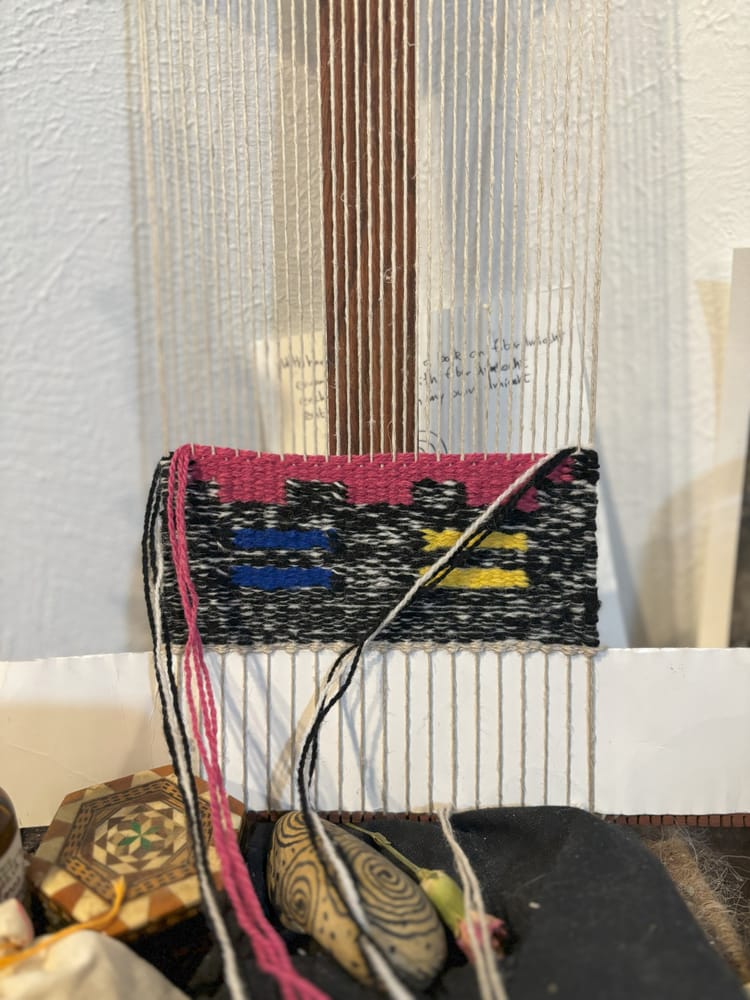
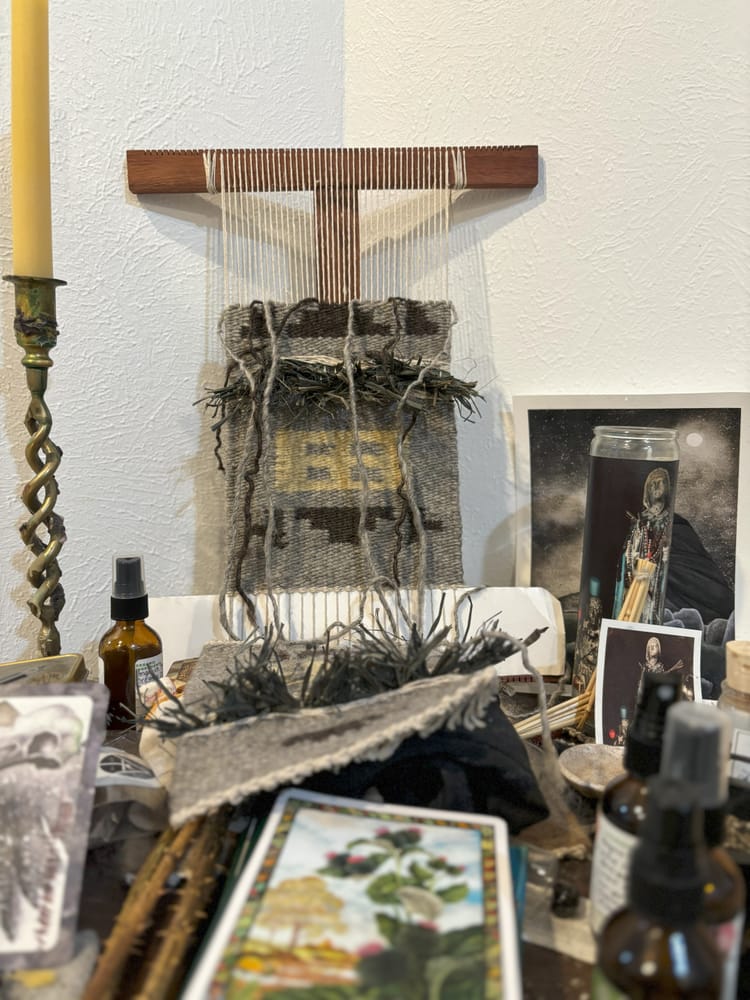
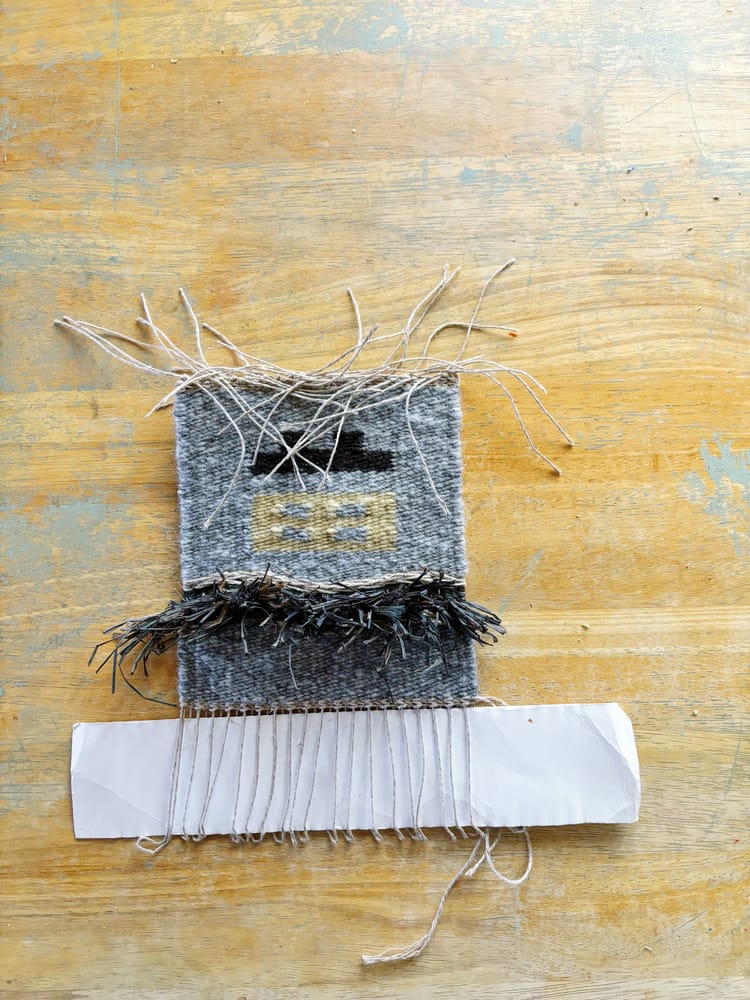
Fiber death work is when that death work is performed with any form of fiber art (i.e., weaving, spinning, knitting, crocheting, macrame, etc.) as a key component. As a weaver and handspinner that has always spun, weaved, and natural dyed as a way to process personal and societal deaths, my primary death work toolkit has going to be very fiber-centric. For example, I started weaving, because it was my mom’s unfinished work before she passed. By learning to weave, I did the work she could not finish, which healed any outstanding regret she might have carried into the other world and helped me heal from her loss. Weaving became my nightly ritual where I worked with my grief, sadness, and frustration around her death, inviting those feelings in to not get lost and bogged down in them. That is fiber death work at its simplest where one becomes reborn through navigating the fires of mourning and grief in the creation of meaningful cloths or tapestries.
Yet, once I opened the door and shared about my own fiber death work, the door opened for me to conduct fiber death work for others. I still remember getting that first invitation in an email from my friends, who were grieving the loss of three loved ones who died too soon, around the Winter Solstice. They requested that I craft them a custom weaving to remember their little ones. With the help of my friend Hannah (@mourninglightdivination), who is a Persian Death Witch, we crafted a weaving and ritual to help those three souls find their rest and help the parents heal so they could move on with their parenthood journey. Being invited into fiber death work for others changed everything. After that experience, there was no denying the magick that poured out of my fingers from the loom. Henceforth, I knew that I would always be practicing a form of magickal fiber death work for others as the call came that helped others move through the death and rebirth process, whether those deaths be personal, familial, or collective.
There is a unique and powerful form of reciprocal magick at play in these fiber death work offerings. Helping people mend their hearts, find new pathways through relationships, and transition to the other world is the minimum I could do to help others with these tools. Yet, that is the work of practicing good, real magic Phillip Carr-Gomm’s tells us:
Yes, for in serving others with the magick of fiber death work, I have found equal return for myself in alignment with the rule of return (termed the “Rule of Three” in some traditions), a belief that states that what you put out into the world will return to you 3-fold, 10-fold, or 100-fold. My gift for providing this magick for others has been to view new horizons in fiber death work practice; Horizons that bring about healing and rebirth through familial and collective forms of death.
My current commission is an excellent example of the universe gifting me new horizons in familial death work weaving. Rachel Wylie, a weaver and death worker, commissioned me to do a weaving to mark her transition into being a storyteller and flame bearer for her own rekindling of ancestral practice in her family. Alongside my own path, she has been walking to find the old ways within her own ancestral lineage and explore death work offerings. The weaving I am building for her will mark her becoming a cornerstone for her own family where her life will be the impetus for her future descendants moving outwards in a thousand directions of wisdom and connection. This weaving serves as a sort of aspirational summoning that reaches to soothe and heal ancestral trauma while it simultaneously builds the path toward a different future for Rachel and her family.
And yet, there are even broader horizons that I wish to walk toward. As I have been crafting this fiber death work, I have felt the call to conduct fiber death work at the collective level. I feel this tugging deep inside to make large scale work that can be a vessel for all our collective mourning and grief over watching our own world crumble before our eyes and being tasked with the work to rebuild it for our children. Though my 4 ft. x 6 ft. loom may look like its empty, it sits full of my future fiber death work weavings that fulfill this deep yearning inside me. They have already been imagined and designed in my head. Its only a matter of time before they manifest into being. Once brought into being, I believe those weavings, similar to the work I conducted for Rachel, can help us do the necessary death work and then carry on with the work of building a more egalitarian, inclusive world.
But, what good is all this fiber death work if only one person is practicing it? In short, it’s not good enough. As I often close these pieces, I call out to you, dear practitioners. Just because I have defined what fiber death work is does not give me some sort of license or monopoly on its use. No, that’s some backwards capitalist BS. We need everyone who is willing and able to help our society walk across that threshold and take the first steps into a new world of our choosing. Pick up yourself from the ashes of this time and know you still have the power to craft that new world. The more who answer the fiber death work call the more likely we will be successful in building that imagine paradise of our dreams.
Thanks for reading! Subscribe for free to receive new posts and support my work.
Weber, Max, The Protestant Ethic and the Spirit of Capitalism. Most notably, I am referencing this excerpt from Weber’s work: “One of the fundamental elements of the spirit of modern capitalism, and not only of that but of all modern culture: rational conduct on the basis of the idea of the calling, was born from the spirit of Christian asceticism. . . . The Puritan wanted to work in a calling; we are forced to do so. For when asceticism was carried out of monastic cells into everyday life, and began to dominate worldly morality, it did its part in building the tremendous cosmos of the modern economic order. This order is now bound to the technical and economic conditions of machine production which today determine the lives of all the individuals who are born into this mechanism . . . with irresistible forces. Perhaps it will so determine them until the last ton of fossilized coal is burnt. In Baxter’s view, the care for external goods should only lie on the shoulders of the “saint like a light cloak, which can be thrown aside at any moment.” But fate decreed that the cloak should become an iron cage.” ↩
O’Donohue, John, 2004, Anam Ċara, pg. 174-177, Harper Perennial. ↩
O’Donohue, John, 2004, Anam Ċara, pg. 178, Harper Perennial. ↩
O’Donohue, John, 2004, Anam Ċara, pg. 178, Harper Perennial. ↩
Phillip Carr-Gomm, 2016, Lessons in Magic: A Guide to Making Your Dreams Come True, pg. 17-19, The Oak Tree Press. ↩
Phillip Carr-Gomm, 2016, Lessons in Magic: A Guide to Making Your Dreams Come True, pg. 2-3, The Oak Tree Press. ↩


Member discussion